-

Courtyard terrace
-
Main view from the outside
-
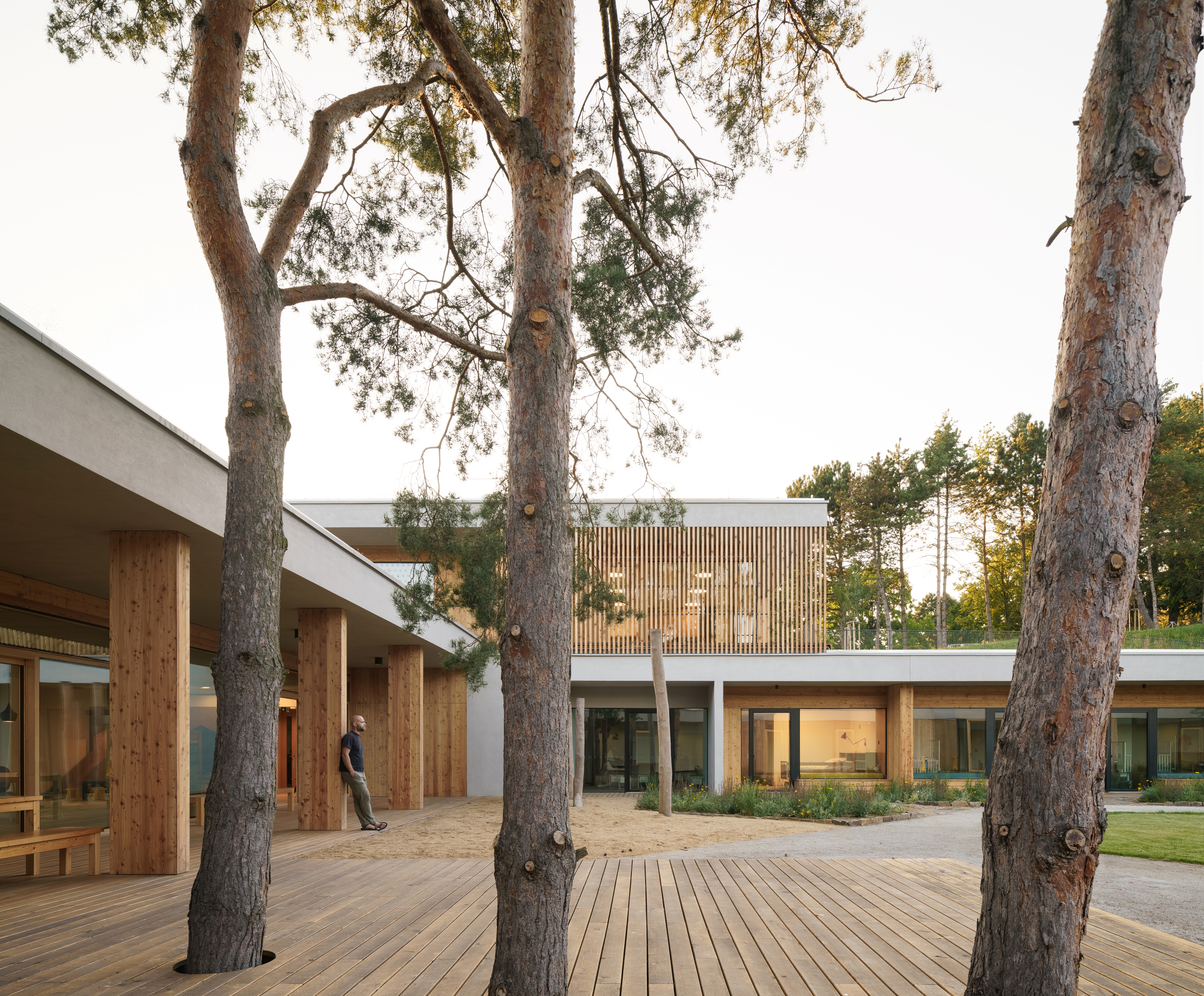
Main courtyard with mature trees
-
Small atrium near the entrance
-
Care room
-
Main communal area with kitchen and dining space
-
Site plan
-
Basement – administrative and service floor
-
Main floor - therapy, communal area and care rooms, farewell apartment
-
Upper floor - family accomodation
-
Section
-
South-west view
Children's Hospice - House for Julia
Čtyřstěn. Brno, Czechia
-
Name of work in English
Children's Hospice - House for Julia
-
Name of work in original language
Dětský hospic Dům pro Julii
Prize year
EUmies Awards 2026
-
Work Location
Brno, Czechia
-
Studio
Čtyřstěn
EUmies Awards 2026 Nominees


The first children’s hospice in Czechia. It provides palliative and respite care, rehabilitation, therapy, and comprehensive support for families facing the most difficult moments. It is both a refuge and a home - a place to share joy and sorrow, to find peace, community, and acceptance.
Collaborators
Landscape: Marek Holán; Collaborator (office): Martina Fojtíková; Collaborator (office): Nikola Korábová; Collaborator (office): Tereza Minárová; Collaborator (office): Monika Mozolová; Structure: Roman Koplík; Lightning protection: Jiří Kozlovský; Structure: Atelier LIPROJEKT; Fire Safety and Accessibility: Staviař; Sanitary infrastructure: Projekt 315; Ventilation: Michal Kysilka; Heating and cooling technology, High voltage electrical systems: TPS Projekt; Low-voltage electrical systems: Alexa-projekce; Traffic and Transport: Rostislav Beneš; Pool technology: CENTROPROJEKT GROUP; Construction management: UNISTAV CONSTRUCTION a.s.; Lake: Small lake; Atypical built-in furniture, wooden cladding, terraces: Sollus nábytek; Plasters: Qualibau; Lighting: ATEH; Sanitary partitions: ADI interier; Monolithic load-bearing construction: GEMO; Green roof: Flora Urbanica; Interior doors and glazed walls: Mirror; Landscape: Urban Forestry
Program
Health
-
Labels
Children & Youth
Site area
7146 m²
-
Client
Dům pro Julii, City of Brno
Total gross floor
2712 m²
Cost
2691 €/m²
Set in a quiet park on the outskirts of Brno, House for Julia offers palliative and respite care in a calm, homelike environment. The building follows the natural slope, enclosing a courtyard with mature trees and a pond. Concrete, larch, and glass define a restrained yet warm architecture. Generous glazing, terraces, and roof paths connect interior and landscape, allowing children to experience light, nature, and movement often absent from clinical care. The design promotes openness and quiet continuity, blurring boundaries between care, home and garden while remaining private and functional.
The project confronted the challenge of designing a hospice that could provide long-term care not only for children with serious illnesses but also for their families. Each family member faces different physical and emotional needs, requiring a spatial concept with varying levels of intimacy while maintaining functional clarity. The design was shaped through intensive dialogue with families seeking such support and by studying several international facilities specialising in palliative care. Our strategy redefined the hospice as a sanctuary rather than an institution — a place where psychological well-being is as vital as medical care. Hierarchy and isolation were replaced with continuity and openness: private rooms, therapy areas, and family or communal spaces are linked in a calm circular flow. Integration with nature became the key therapeutic principle, while a farewell apartment with a memorial atrium ensures that even the hardest moments unfold in privacy, peace, and dignity.
The building is integrated into the terrain, allowing barrier-free access from the outside to each of its three levels. Monolithic reinforced concrete is used as the primary structural material, providing strength, durability, and thermal stability. Its character is expressed in the interior, while the exterior is finished with concrete-gray polished plaster complemented by larch cladding and large-format glazing in wooden frames. The overhangs of the concrete slabs cover terraces and entrances, providing shelter and passive shading to prevent overheating of the interior despite the generous glazing. Heating and cooling operate through a conduit system embedded in the concrete and fibre-cement ceilings, supplied by three air-to-water heat pumps concealed within façade niches. Green roofs reduce heat gain, retain rainwater, and visually anchor the building in the surrounding terrain. The natural aging of exterior materials helps the house blend into its setting and reduces maintenance.