-

inner terraced 'Central Garden'
-
View from the slag heap
-
Exhibition hall with roof sheds
-
City-side entrance
-
Upper entrance
-
Inner courtyard and industrial chimneys
-
plan +1
-
sections
-
competition drawing
-
competition drawing
-
competition drawing
-
Scale model
Charleroi Palais des Expositions
AgwA, architecten jan de vylder inge vinck. Charleroi, Belgium
-
Name of work in English
Charleroi Palais des Expositions
Prize year
EUmies Awards 2026
-
Work Location
Charleroi, Belgium
-
Studio
AgwA, architecten jan de vylder inge vinck
EUmies Awards 2026 Architecture winners
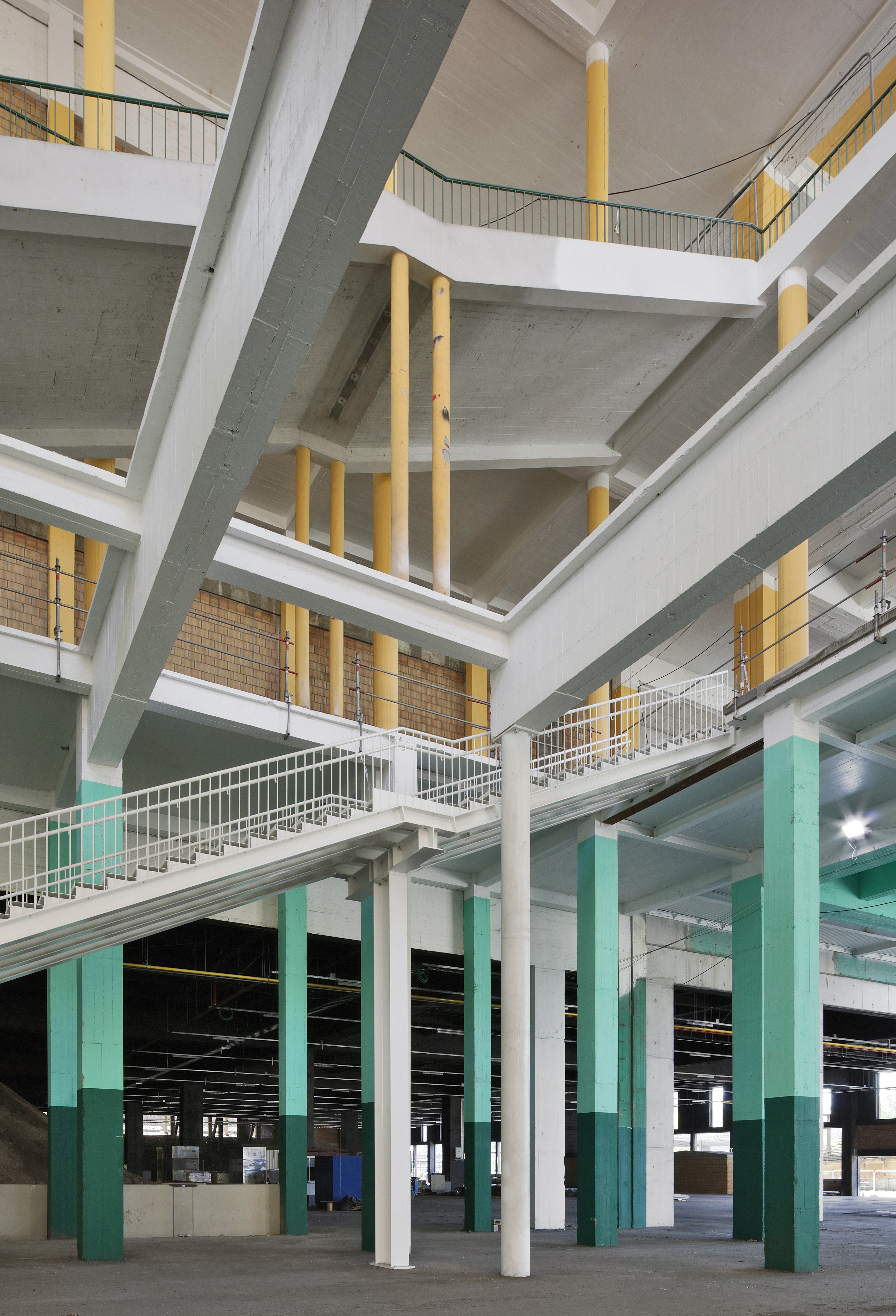


Renovation of a 1950s convention centre. The stripped central hall transforms into covered urban terraces. Targeted interventions prioritize flexibility and circulation. Demineralization turns black ground into a continuous green park. The building as it was but never seen before.
Collaborators
Landscape: Denis Dujardin; Interior Design: Doorzon Interieurarchitecten; Building physics: Bureau Greisch; Structure: Bureau Greisch; Fire Safety and Accessibility: Delta GC; Acoustics: progrs; Association of Construction Companies: Bémat-Moury-Koeckelberg-Duchêne
Program
Culture
-
Labels
Congress Centre · Culture Centre · Exhibition · Dance
Site area
37700 m²
-
Client
City of Charleroi
Total gross floor
50000 m²
Cost
1075 €/m²
The project explores the potential of this vast volume, situated on sloped terrain, while preserving its extraordinary qualities such as scale, rationality, and monumentality. The aim was to reassess the historical and heritage value of each part of the existing structure, to guide precise decisions on demolition, conservation, and renovation. Architectural interventions aim to be as undesigned as possible. Circulation is being rethought. The project literally invites public space, parking, and landscape to invade the building, while reconnecting the city center with its surroundings.
The brief proposed replacing the central hall with a low-energy building, but the budget was only 1/3 of what was needed. Instead, the center was opened and its façades stripped to create a covered outdoor space, effectively a ‘zero energy’ structure. An atrium was carved through the first floor to connect with the dark ground floor, thus creating a three-level garden at the heart of the project. The south wing was repurposed as a multi-storey car park, further reducing the thermal envelope to the northern volume. Thoughtful demolitions created intelligent solutions, such as a naturally ventilated car parking floor; or the demolition of a damaged concrete slab to turn parking into parc. The slag heap on which the building stands was exposed and seeded with native plants to create an eco-rich landscape. During construction, the demand came to integrate a congress centre. A new balcony was introduced, as if the new project was an opportunity to show the potential of the first.
Respectful reuse guides the project, revealing and enhancing what was already there; a form of architectural archaeology balancing economy, ecology and aesthetics. Architectural interventions are limited to punctual, precise interventions. Current norms are applied, such as doubling the green railings to meet current security standards. Demolished elements are converted into urban furniture. The old concrete was protected with white anti-carbonization paint. Surfaces were repainted in white, or using the color codes of former uses (e.g., green for tennis courts) restoring familiarity and helping people reconnect with the building in its renewed form. Special techniques were limited, natural ventilation welcomed. Materials are durable and straightforward; vegetation low maintenance. The building’s original flexibility is enhanced and projected into the future: it is now an explicit identity of the Palais des Expositions. This renovation is not an end point, but it allows the building to evolve and live anew.