-

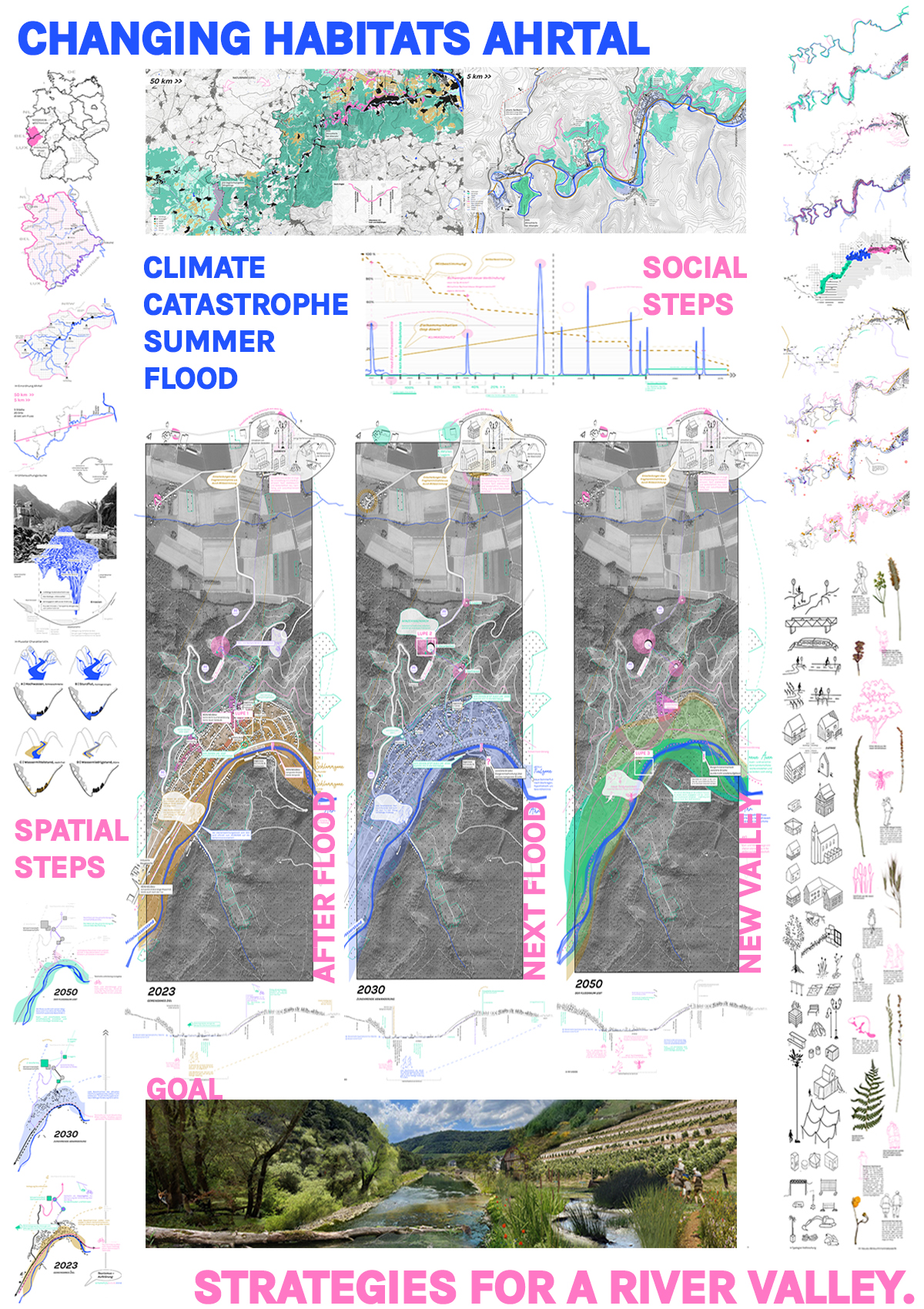
changing habitats - ahr valley as a case study for flood desasters
-
summer flood events
-
transformation in spatial and social steps
-
from mud phase, over new flood phase, to new landscape
-
phase 1: how a resettlement could work
-
phase 2: new element working as a spatial and social hinge
-
transformation in vertical sections to the river
-
changing habitats
-
Changing Habitats Ahrtal
Julia Theis. Ahr Valley, Germany
-
Name of work in English
Changing Habitats Ahrtal
-
Name of work in original language
Strategies for a River Valley
Prize year
Young Talent 2023
-
Work Location
Ahr Valley, Germany
-
Author/s
Julia Theis
-
School
Faculty of Architecture and Landscape Sciences - Leibniz Universität Hannover.
Hannover, Germany
Young Talent 2023 YT Nominees


Changing Habitats Ahrtal
Strategies for a River Valley
Program
Culture
-
Labels
Nature
‘23 the demand for climate protection and a resilient future strategy is becoming ever greater. Natural disasters overrun our cities because they aren‘t dynamic. We built them in the middle of a landscape that once regulated itself. Now we have the chance to change and shape these building processes. We must not look away at a reconstruction in a death zone.
The flood disaster in the Ahr valley in July 2021 is the trigger and the current occasion for this project. The new situation is seen as an opportunity to test scenarios of how the Ahr valley could live in the future. In this context, the word ‘life‘ does not only stand for human life, but also all the life of flora and fauna. The Ahr valley serves as a 'case study' for a place that occurs as a typology in many low mountain regions, but is now currently affected by a flood and the issue of reconstruction. How does the Ahr Valley, as a case study, live in the future? During processing it has emerged in the course of the work that a resettlement of the villages directly on the Ahr is necessary. It is important that such a process happens without coercion, on a voluntary basis. Here, the design shows how a resettlement dynamic can develop with new connections. The new connection, vertical to the river and its places, is an important spatial, but also social element that can be complemented with economic or environmental focal points. The resettlement of people in this process is the necessary means to an end for the emergence of two new dynamics in the valley and beyond. The overarching goals here are climate and human protection. One dynamic is the main goal: the development of a natural river course and a changing landscape that is gently experienced by people. This development is to be considered uniformly on the 50 km section. The other dynamic is the new vertical connection from the villages near the river across the mountain to existing villages on higher ground. The vertical connections may develop in different ways. This important dynamic doens’t exist just yet and has emerged from the design process within the work. The vertical connection to the river and thus away from the river is necessary for people to embrace resettlement and be willing to 'release' the valley. The work gives an example about the development of a place on the Ahr with the consideration of both dynamic directions and shows how the Ahr valley can live in the future.