-

Working and Living on the Water
-
Issue: Daily Tidal Flooding
-
Site: The Knysna Estuary and its Unique Mixing Patterns
-
Intervention: The Oyster Reef
-
Ground Floor Plan
-
Spaces: Inhabitation
-
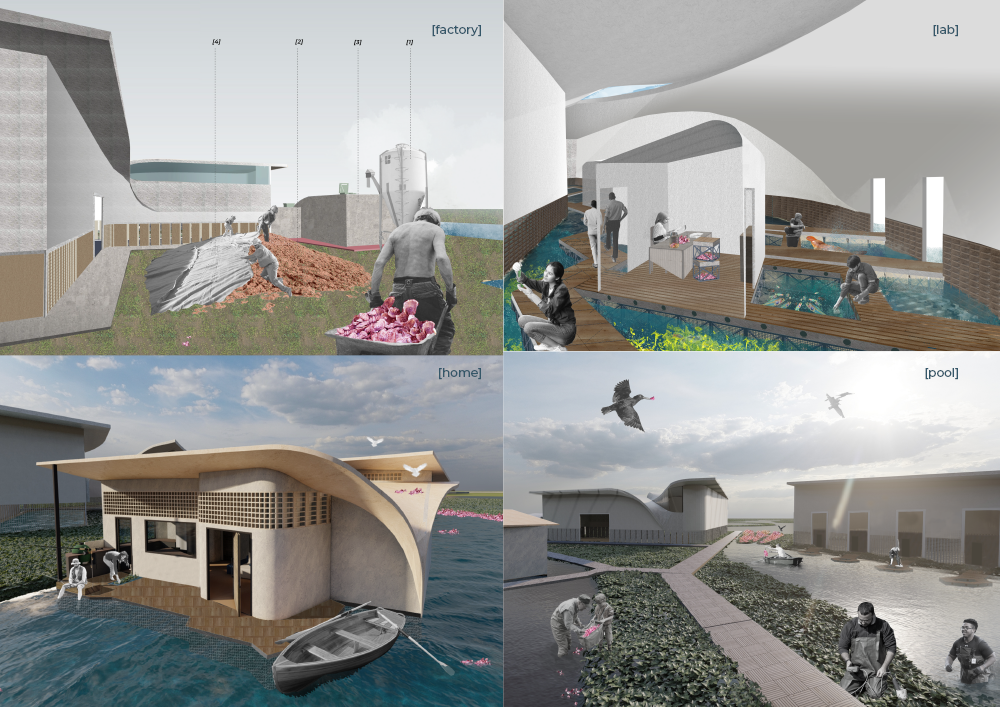
Renders: Floating Research Centre, Residences, and Exterior Research Spaces
-
Project Summary
-
Buoyanc[it]y
Casey Sack. Knysna, South Africa
-
Name of work in English
Buoyanc[it]y
-
Name of work in original language
Inhabiting the Waters of the Knysna Estuary – Resuscitating Life Drowning in the Rising Sea
Prize year
Young Talent 2023
-
Work Location
Knysna, South Africa
-
Author/s
Casey Sack
-
School
School of Architecture and Planning - University of the Witwatersrand.
Johannesburg, South Africa
Young Talent 2023 YT Open Nominees



Buoyanc[it]y
Inhabiting the Waters of the Knysna Estuary – Resuscitating Life Drowning in the Rising Sea
Program
Landscape
-
Labels
Regeneration
With a focus on the South African town of Knysna, the intervention confronts the global threat of rising seas, and the need for a flood-proof architectural response. The design of the system mimics estuaries, to create floating buildings made from oyster-derived fibreglass. Programmes include a research centre and habitats for humans, birds and fish.
Thesen Island will be underwater by the year 2100. This island is the site of intervention. It is a residential marina located in the Knysna Estuary, in South Africa. The project proposes a floating development to replace the flooded homes. The structures are made of fibreglass, and rise and fall with the daily tides. The tides vary over the course of the day, exposing and swallowing the land. We can’t stop the rising seas, so how can we rise with them? The design looks to nature for the answer, and finds solutions in biomimicry. The intervention mimics the qualities of the estuary by simulating the water’s mixing pattern to create sand. As river water crashes into seawater inside estuaries, they mix in a spiralling pattern. This movement creates sand particles which eventually compact to create land. The hero of the intervention is the oyster, which is another source of sand production. After the oysters die, their shells break down. The project explores the potential for these shells to be crushed to make sand used to make sustainable fibreglass. Oysters grow rapidly and form a reef – living breakwater along the edge of the site, shielding the land from waves. The programmes include an ecological research centre, residential units for researchers, and a fibreglass factory, where the floating building bases are constructed. The platforms are made of modular, adaptable boxes, and allow for the curation of a series of different labs used for ecological research purposes. In addition to human programmes, the oyster reef becomes a habitat for the birds that used to reside in the site’s now flooded bird reserve. Oysters also filter water, and are a food source. The intervention becomes a multi-species habitat, protected, fed, and constructed by oysters. Each building becomes a site for additional oyster growth, thus each becomes part of the architectural ecosystem. This intervention transcends beyond the physical architectural structure, to create a system which can be replicated in estuaries globally, by balancing infrastructure with nature at the coastal edge, resuscitating life drowning in the rising sea.