-

Main entrance of the Borsoni Theatre
-
Night view of the main entrance of the Borsoni Theatre
-
Side exterior view of the Borsoni Theatre
-
Exterior view of the Borsoni Theatre
-
Interior view of the Borsoni Theatre
-
Interior view of the main theatre hall of the Borsoni Theatre
-
Ground Floor
-
First floor
-
Elevations
-
Longitudinal section
-
Detailed cross section
-
Detailed cross section
Borsoni Theatre
Brescia Infrastrutture srl, Camillo Botticini architect. Brescia, Italy
-
Name of work in English
Borsoni Theatre
-
Name of work in original language
Teatro Borsoni
Prize year
EUmies Awards 2026
-
Work Location
Brescia, Italy
-
Studio
Brescia Infrastrutture srl, Camillo Botticini architect
EUmies Awards 2026 Nominees
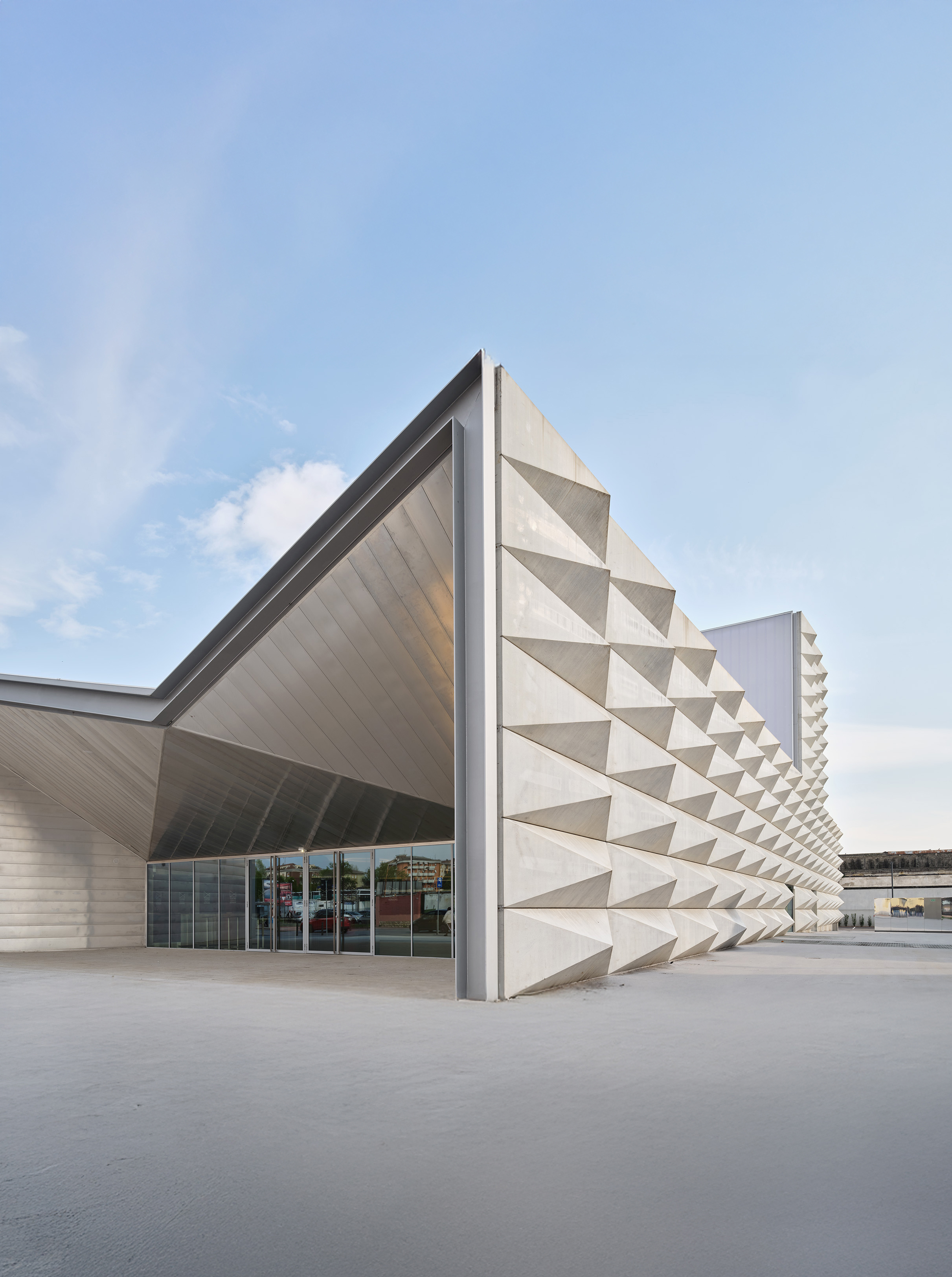


From industry to culture: a new civic hub in Brescia transforms a former factory site into a contemporary theatre. The project redefines the industrial landscape through architecture that merges public space, material clarity and urban regeneration.
Collaborators
Project Manager (Public Authority): Gianpiero Ribolla; Technical Assistance to the Project Manager (Public Authority): Gianluigi Barucco; Technical Assistance to the Project Manager (Public Authority): Laura Treccani; Design, Coordination, and Technical Direction of the project: Camillo Botticini - Botticini + Facchinelli ARW; Project Leader: Paola Daleffe - Brescia Infrastrutture srl; Project Director: Alberto Merlini - Brescia Infrastrutture srl; Collaborator (office): Stefano Bordoli - Brescia Infrastrutture srl; Collaborator (office): Paolo Livi - Brescia Infrastrutture srl; Collaborator (office): Massimo Torquati - Brescia Infrastrutture srl; Artistic Direction: Botticini + Facchinelli ARW; Construction management: GAP Progetti srl; Construction management: Silvia Foini; MEP Works Supervision: Fabio Zenocchini - Sigma Project Engineering S.R.L.; Construction company: Sabino Dicataldo; Structure: Alessandro Gasparini; MEP and Electrical Design: Andrea Andreis; MEP and Electrical Design: Fabio Bolzoni; Acoustics: Eleonora Strada; Acoustics: Emanuele Morlini; Design of the Stage machine – Stagecraft: Giorgio Molinari; Stage machine: Molpass srl; Furniture Design Project Manager: Alice Dodesini - DODiCI Architettura; Graphics: Glifo soc. coop.
Program
Culture
-
Labels
Theatre · Culture Centre
Site area
7000 m²
-
Client
Municipality of Brescia
Total gross floor
3500 m²
Cost
10500000 €/m²
Located in Brescia’s former industrial district along via Milano, the project forms part of the city’s regeneration plan “Oltre la Strada”. On the site of a dismantled factory, it establishes a civic theatre with two halls and a new public square that defines a contemporary urban space for gathering and cultural life. The building’s compact volume, defined by prefabricated rusticated concrete panels and translucent polycarbonate cladding, reinterprets the industrial material language of the place, while interiors in wood and aluminium create a warm, inclusive atmosphere for cultural exchange.
The project faced several challenges: a very limited budget, a fragmented urban context and the ambition to create a cultural facility accessible to all citizens. Located in Brescia’s declining industrial district, the site lacked identity and public life. The strategy was to concentrate resources in a compact, efficient volume capable of generating a new civic focus. Prefabricated concrete panels, polycarbonate and simple construction methods reduced costs while ensuring a strong architectural expression. The challenge for us was to hybridise advanced off-site techniques, standard systems available on the market and handcrafted details refined during the design phase. Integrating these components within a tight budget required precision and close collaboration with the contractor, whose organisational quality was crucial to achieving a coherent and balanced result once construction was completed.
The project is based on off-site construction principles and environmental reversibility assessed through LCA and compliant with national CAM criteria. Exposed concrete, aluminium and polycarbonate are used without surface treatment, reducing maintenance and ageing uniformly over time. The 19-metre-high stage tower is clad with backlit polycarbonate panels that ensure lightness and visibility, while prefabricated rusticated concrete panels define the building’s tactile identity. Structural simplicity, standardised components and careful detailing allowed cost control and rapid assembly. The combination of off-site systems and artisanal precision embodies a sustainable approach balancing economy and quality. Maintenance is minimal: periodic cleaning of polycarbonate surfaces and of the roof, together with routine inspection of joints, preserves the building’s material integrity.