-

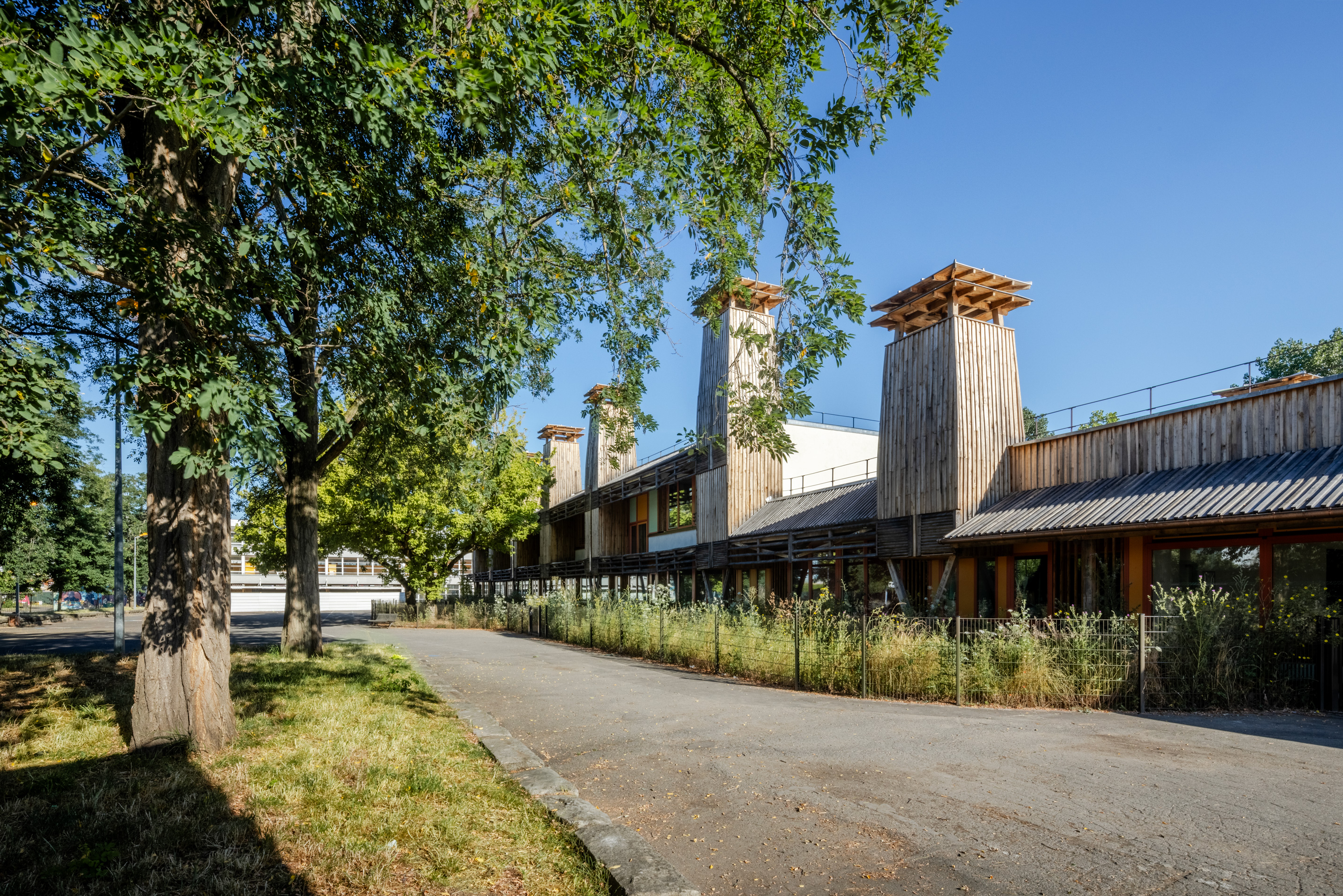
South facing elevation
-
Existing building prior works
-
Perenial straw external insulation
-
Wind towers and new façade under construction
-
South facing elevation
-
Straw insulation behind cladding
-
Site plan
-
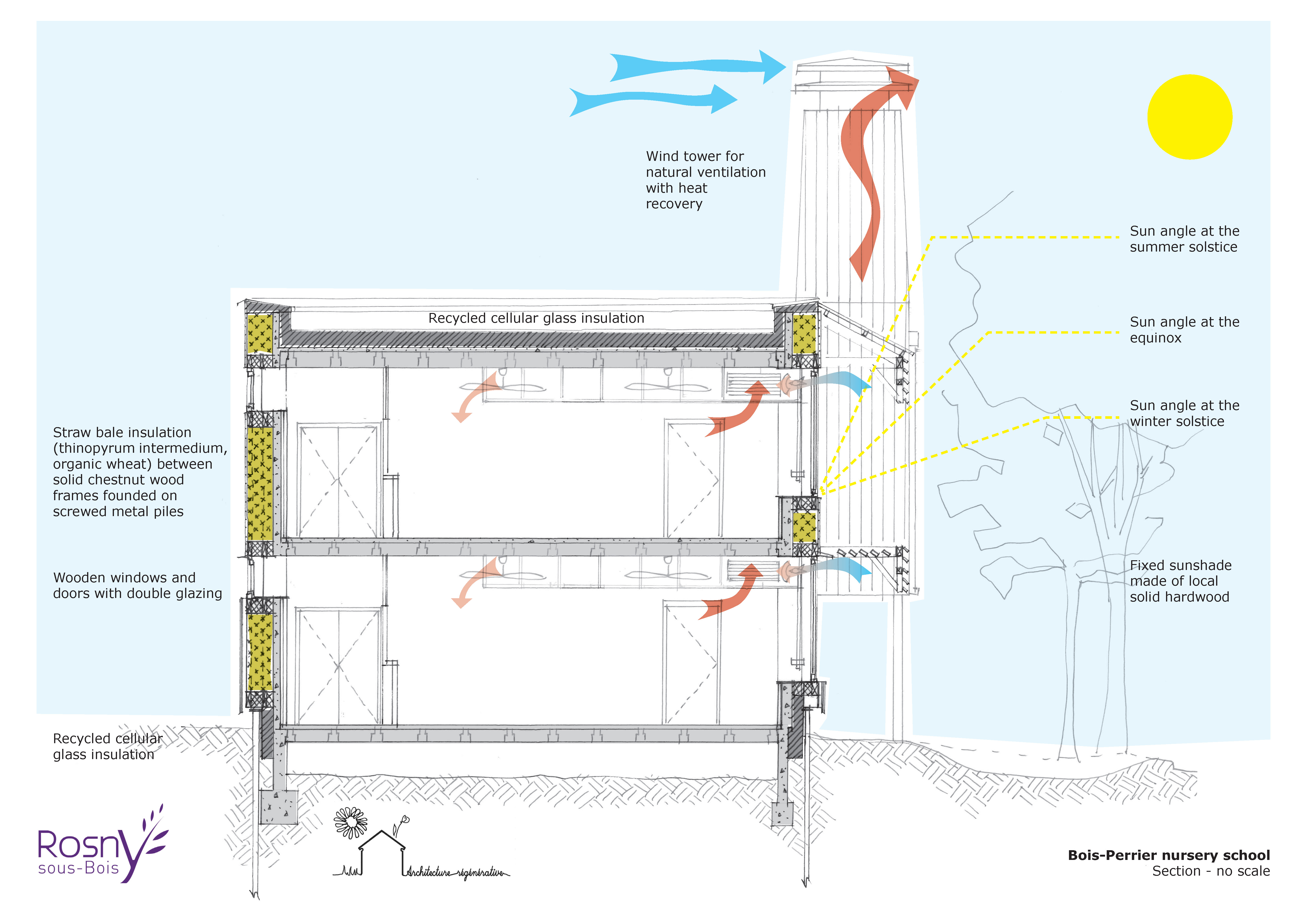
Sectional view
-
Detailed section
-
Schematic of the natural ventilation system
Bois-Perrier Nursery School
Direction Recherche et Innovation de la Ville de Rosny-sous-Bois. Rosny-sous-Bois, France
-
Name of work in English
Bois-Perrier Nursery School
-
Name of work in original language
Ecole maternelle Bois-Perrier
Prize year
EUmies Awards 2026
-
Work Location
Rosny-sous-Bois, France
-
Studio
Direction Recherche et Innovation de la Ville de Rosny-sous-Bois
EUmies Awards 2026 Nominees




Towards a regenerative architecture
The act of building globally destroys our environment and the ability to live in harmony with ourselves, the planet and all its inhabitants. Returning to an architecture of the commons through a public architecture department could be a way to achieve our regenerative goal !
Collaborators
Bureau de contrôle: Laurent Dandres - APAVE
Program
Education
-
Labels
Children & Youth · School
Site area
25625 m²
-
Client
Ville de Rosny-sous-Bois
Total gross floor
1500 m²
Cost
5000000 €/m²
The Bois-Perrier nursery school was built in the 1960s by architect Jean de Mailly. Like many buildings from that era, it lacks insulation, ventilation, solar protection, resulting in severe thermal discomfort for users. Its renovation aims to extend the building’s lifespan while ensuring functionality and comfort in light of climate, environmental, social changes and energy depletion. The work focuses on renovating the existing structure using a self-supporting structure insulated with straw and implementing a low-tech natural ventilation system with heat recovery.
Our aim : to reduce the impact of construction on ecosystems, by avoiding new constructions, by renovating existing buildings to adapt to global changes. This project experiments a non-standard technique : external thermal insulation with straw from Thinopyrum Intermedium. The use of a perennial cereal reduces pressure on agroecosystems with multiple benefits and the use of local biosourced materials (wood, straw) regenerates our ecosystems, contributes to the regional economy and promotes traditional manual skills, fostering collective intelligence. This building also contributes to research through building instrumentation, generating scientific data to be shared. It also furthers our research on natural ventilation with heat recovery, aiming to implement low-tech systems that reduce dependence on fossil fuels and rare earths. Manual controls allow users to manage the building’s ventilation. Finally our department conducts training sessions to ensure proper user engagement.
External thermal insulation with self-supporting wooden structure and straw insulation, on metal screw piles. Structural materials : Solid regional hardwood (chestnut, oak) and reused wood for secondary framing. Insulation materials : external thermal insulation using straw from Thinopyrum intermedium and organic wheat. Additional insulation with recycled cotton, cork and recycled glass. Ventilation : natural ventilation with heat recovery and low maintenance. Heating : urban geothermal heating, supplemented by a masonry stove for autonomy. Cooling / summer comfort : fixed external solar protections in solid wood on the south side, night-time over-ventilation during heatwaves, ceiling fans indoors. No active cooling! Other features : on-site reuse of sanitary equipment, paving stones and acoustic panels, harvesting and purifying rainwater, water management via landscape swales. User engagement in thermal comfort and ventilation control. We aim at simple and user-friendly maintenance !