-

View of the main façade
-
View of the inner courtyard entrance
-
Office Interior
-
View from the walkway overlooking the double-height entrance
-
View of the main street entrance
-
View of the empty space
-
Maquette of the project
-
Maquette of the section of the project
-
Axometrical section of the double height entrance
-
Ground Floor
-
First Floor, Typical Floor, Rooftop
-
Longitudinal Section
Bicocca Superlab
BALANCE ARCHITETTURA. Milan, Italy
-
Name of work in English
Bicocca Superlab
-
Work Location
Milan, Italy
-
Studio
BALANCE ARCHITETTURA
Nominees
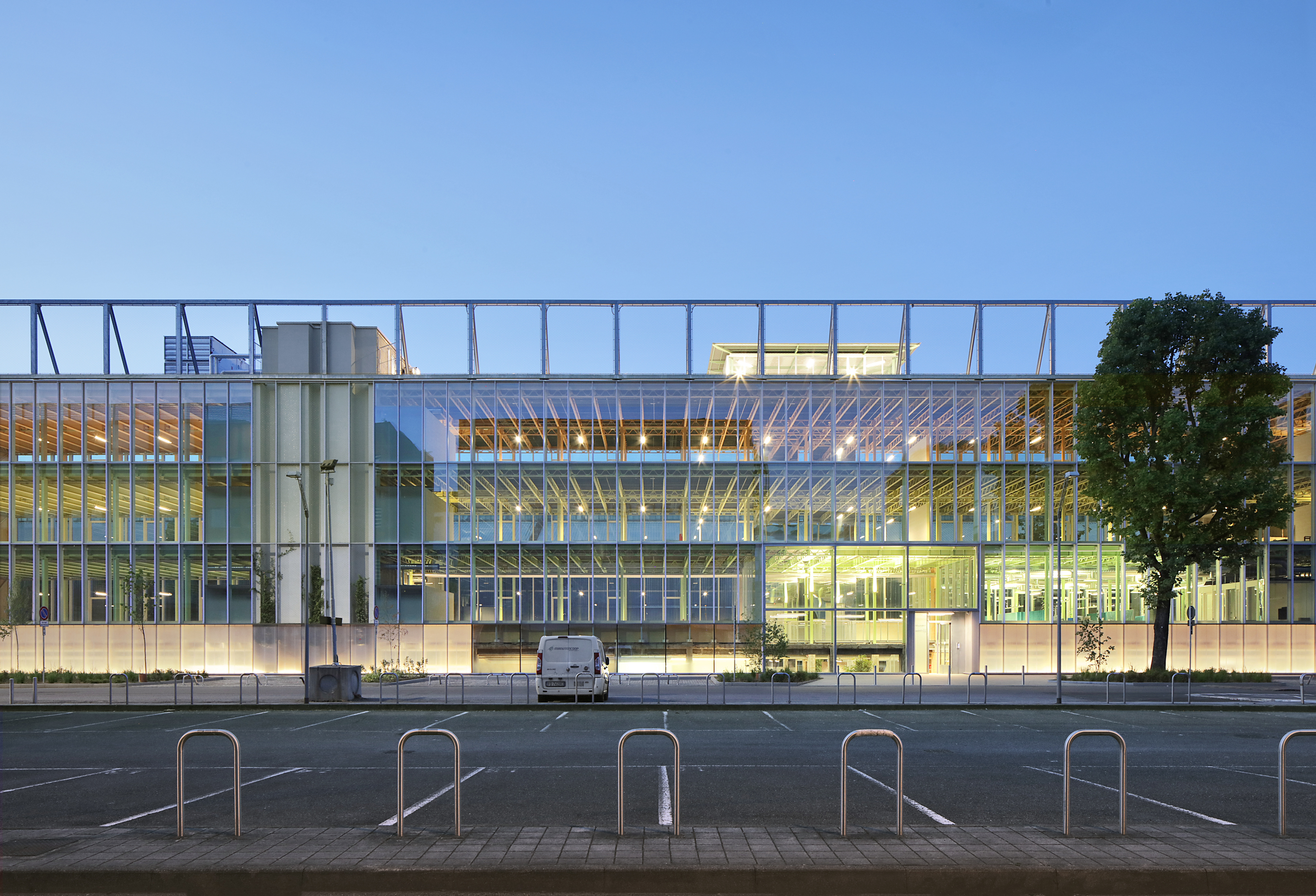


Bicocca Superlab is an urban regeneration project transforming a former industrial building into a carbon neutral workplace, merging exposed structure, adaptive spatial strategies and a light-reactive facade as a contemporary model of ethical innovation through a essential architectural approach.
Collaborators
Collaborator (office): Davide Minervini - BALANCE ARCHITETTURA; Collaborator (office): Alejandra Mora - BALANCE ARCHITETTURA; Collaborator (office): Giorgio Salza - BALANCE ARCHITETTURA; Collaborator (office): Giulia Barbero - BALANCE ARCHITETTURA; Collaborator (office): Claudio Carrieri - BALANCE ARCHITETTURA; Project management: Corrado Corradino - STUDIO CORRADINO-PETITTI; Project management: Piercarlo Petitti - STUDIO CORRADINO-PETITTI; Structure: Alessandro Ferro; Fire Safety and Accessibility: Massimiliano Colucci; Consulting: Luca Crudo; Consulting: Alessandro Manzone - AM INGEGNERIA; Consulting: Clara Pistoni - MACRO DESIGN STUDIO; Collaborator (office): Ottavia Mangiafridda - BALANCE ARCHITETTURA; Collaborator (office): Estefania Mujica - BALANCE ARCHITETTURA; Collaborator (office): Egle Tavolaro - BALANCE ARCHITETTURA; Collaborator (office): Sofia Zuccato - BALANCE ARCHITETTURA; Collaborator (office): Nicolò Acquadro - BALANCE ARCHITETTURA; Collaborator (office): Alessandro Stante - BALANCE ARCHITETTURA; Collaborator (office): Alp Arda - BALANCE ARCHITETTURA; Collaborator (office): Gaia Siddu - BALANCE ARCHITETTURA; Collaborator (office): Matteo Dossetto - BALANCE ARCHITETTURA; Collaborator (office): Francesca Rava - BALANCE ARCHITETTURA; Landscape: STUDIO VERDE
Program
Mixed use - Commercial & Offices
-
Labels
Aggregation · Café · Office
Site area
4800 m²
-
Client
MASINI 011 S.R.L.
Total gross floor
6500 m²
Cost
1650 €/m²
Located within Milan’s Bicocca district, the project reinterprets a former industrial facility as an open and flexible workspace that reconnects architecture with its urban surroundings. Rather than replacing the existing structure, it enhances its material presence, brings natural light to previously enclosed interiors, and introduces shared spaces at street level that invite public interaction and restore a sense of collective vitality to the site.
The project confronts the regeneration of an obsolete industrial structure in an area now evolving into a new urban ecosystem of innovation. Rather than replacing what existed, it reveals the hidden potential of the building: its structural logic, material authenticity and spatial depth. The transformation begins by reopening the basement as a luminous and permeable ground level, reconnecting the architecture with the city and its public life. Lightness, reversibility and spatial continuity are adopted not as formal gestures but as strategic tools to anticipate evolving patterns of work and social interaction. The approach recalibrates rather than adds, allowing future adaptability while preserving the building’s identity. The result is an architecture conceived as open in time as in space — civic, dynamic and capable of staying relevant while continuously transforming.
The project retains and rehabilitates the original steel and concrete frame, deliberately reducing demolition, embodied carbon and waste while preserving the structural character of the building. The existing skeleton is not concealed but carefully cleaned, repaired and rendered visible as a primary architectural element, exposing its material truth and historic resonance. New interventions follow a dry, lightweight and reversible logic: a ventilated facade composed of innovative recyclable materials modulates light and thermal performance, while green roofs and passive strategies mitigate heat gain and enhance environmental comfort. High-efficiency mechanical systems and photovoltaic integration are embedded with minimal visual impact. Every component is conceived for easy inspection, replacement and future reconfiguration. The result is a construction approach where durability and flexibility coexist, and sustainability is treated not as an applied technology but as a structural principle embedded in lifecycle intelligence.