-

Benedictine Monastery in Norcia. The manifesto of cultural continuity.
-
1
-
2
-
3
-
4
-
5
-
6
-
Benedictine Monastery in Norcia. The manifesto of cultural continuity.
-
Benedictine Monastery in Norcia.
Filip Strzelecki. Norcia, Italy
-
Name of work in English
Benedictine Monastery in Norcia.
-
Name of work in original language
The manifesto of cultural continuity
Prize year
Young Talent 2020
-
Work Location
Norcia, Italy
-
Author/s
Filip Strzelecki
-
School
Faculty of Architecture - Warsaw University of Technology.
Warszawa, Poland
Young Talent 2020 YT Nominees




Benedictine Monastery in Norcia.
The manifesto of cultural continuity
Program
Religion
-
Labels
Monastery
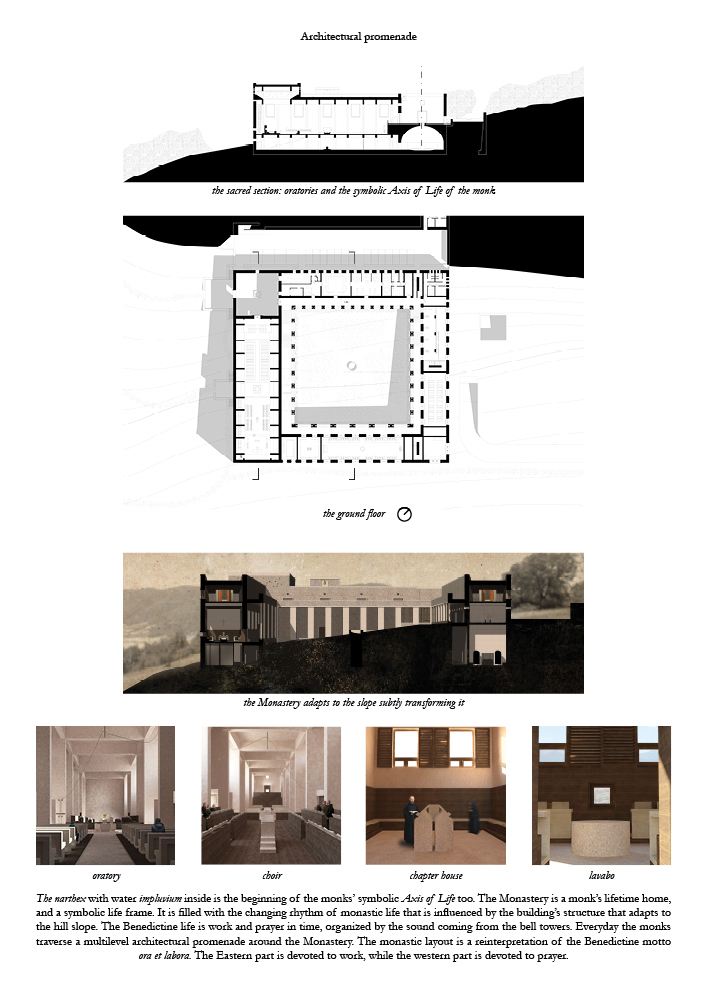
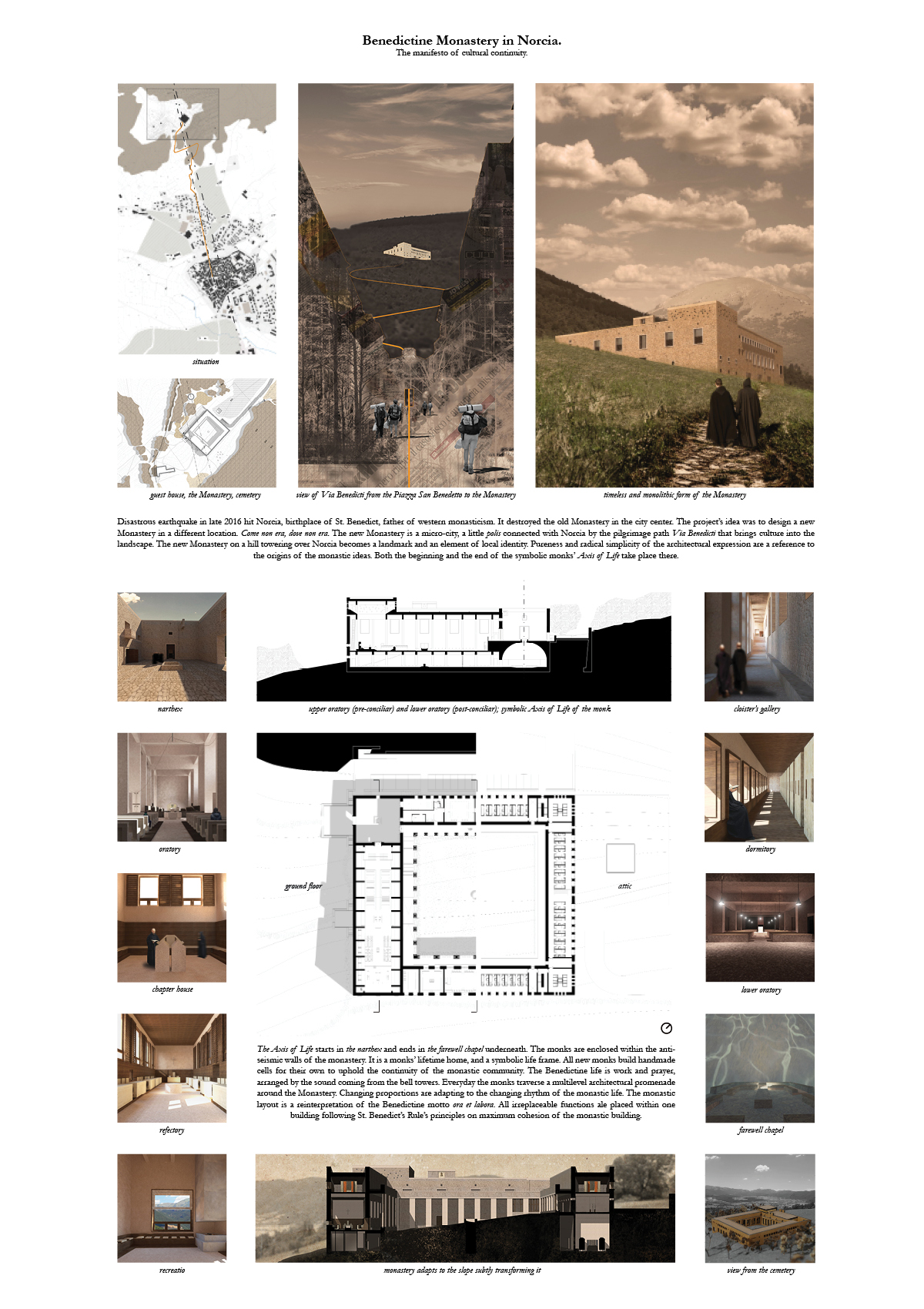
The project is as an attempt to find a way in which architecture can be a medium of information, stories, symbols and meanings. When those are combined within a form, an architectural object is created. The object manifests its continuity in time and space, while simultaneously resisting to the forces of nature.
The Benedictine Monastery is a project located on the southern slope of the Montagna di Civita towering over Norcia. Its location is determined by the axis from the Piazza San Benedetto and the axis of the Valnerina Valley. It ends a sequence of buildings connected with St. Benedict: St. Scholastica's church and the Basilica of St. Benedict. Its structure is made of reinforced concrete mixed with local stone. The foundation is dilatated from the ground with a vibration absorbing mat to resist future earthquakes. It can become a shelter for local society too, when necessary. The project consists of the Monastery, the guest house and the cemetery. The southern slope of the hill is a place for pilgrims to camp. The Monastery is divided into 3 levels and 3 zones of accessibility. The public zone: narthex, oratories. The semi-private: the farewell chapel, the northern offices of the abbot and the brewery warehouse in the basement. The rest is a private monastic enclosure. The Monastery is a monks’ lifetime home and a symbolic life frame. The beginning and the end of the symbolic monks’ Axis of Life take place there. The monastic building is designed referring to the Benedictine motto ora et labora and the St. Benedict’s Rule. In the eastern part (ora) are: library, scriptorium, brewery’s warehouse. In the western part (labora) are: the upper (pre-conciliar) and lower (post-conciliar) oratory and the farewell chapel. Open space dormitory for approx. 40 monks is located in the attic. Each of the new monks builds a private cell and integrates with the space to uphold the continuity of the monastic community. All the spaces are designed as an architectural promenade that overlays with the monks’ rhythm of life which is defined by the liturgy of hours and the sound of the bells in campaniles too. Its changeability reflects in the changing rhythm of pillars, openings and volumes. The form of the Monastery is a timeless architecture referring to monastic origins with a high respect to the context, incorporating local symbols and traditions. Therefore, it can become a manifesto of cultural continuity.