-

View of the astronomical observatory in the landscape
-
Front towards the valley
-
View of the back with view towards the plain
-
Dome of planetarium
-
Panoramic terrace
-
Dome of astronomical observatory with the entrance in the foreground
-
Site plan
-
Basement
-
Ground floor
-
Cross section
-
Longitudinal Section
-
Axonometry
Astronomical Observatory
Studio di Architettura Marco Castelletti. Sormano, Italy
-
Name of work in English
Astronomical Observatory
-
Name of work in original language
OSSERVATORIO ASTRONOMICO
Prize year
EUmies Awards 2026
-
Work Location
Sormano, Italy
-
Studio
Studio di Architettura Marco Castelletti
EUmies Awards 2026 Nominees

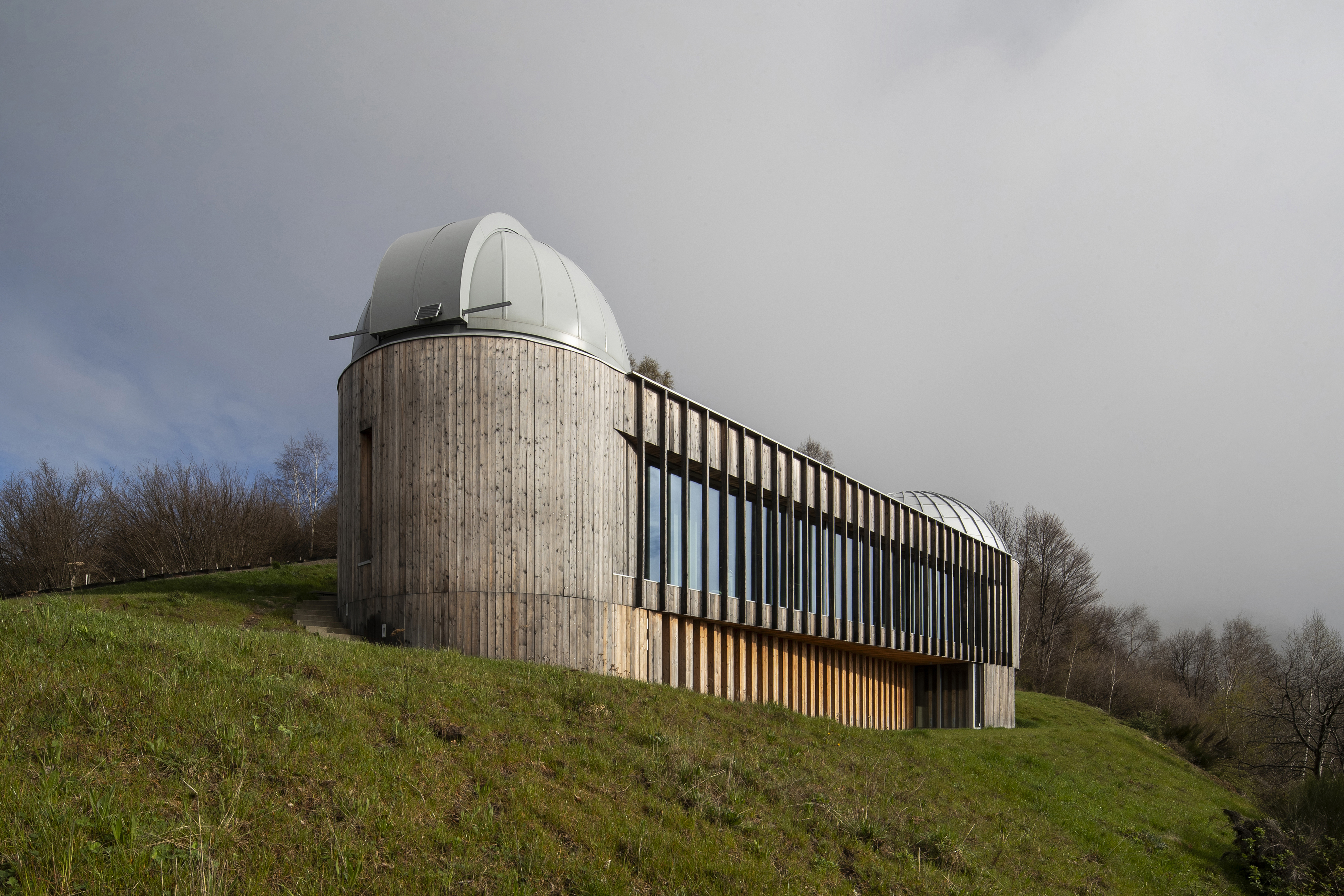


The building was built further upstream than the existing small observatory to satisfy the growing number of school groups and visitors and to create a research and dissemination center in the field of astronomy and is located in a natural protected area of considerable landscape value.
Collaborators
Collaborator (office): Ermanno Yasser Cairo - architetto; Consulting: Paolo Moncecchi - Structural engineer; Consulting: Marco Fortis - Mechanical system engineer; Consulting: Luca Gaffuri - Electrical system engineer; Building works and systems: CREA.MI s.r.l.; Wooden structures: VIVERE IL LEGNO s.r.l.; External cladding in larch boards: GALIMBERTI s.r.l.; Glass windows and external doors: THEMA s.r.l.; Sheet metal roofing and planetarium dome: SOLDARELLI s.r.l.
Program
Education
-
Labels
Research · Nature
Site area
33000 m²
-
Client
Comune di Sormano
Total gross floor
450 m²
Cost
1900 €/m²
Situated on a slope 1.200 meters above sea level and connected to the existing natural paths that ascend mount San Primo, the building relates with the landscape and the panorama tryng to merge in with it with the use of wood as a construction and finishing material. Oriented from south to north, the ground floor houses the two main functions: the astronomical observatory and the planetarium, located at each end and characterized by their respective domes and a multipurpose room located at the center, while the basement accommodates reception spaces for the stay. A panoramic terrace is located between the two domes on the roof garden.
After developing various projects, based on the various possible locations for the new building in 2019 the availability of a municipal land has been confirmed. The position was located 250 meters upstream from the road on the path that, starting from Colma, where is located the old small observatory, ascends toward Mount San Primo. The location was identified on an eastward-sloping slope along the ridge that divides the two sides of the mountain, close to the coppice and overlooking the mountainous landscape, with the Grigna and Mount Resegone mountains standing out in the foreground. The primary objective of the concept was to design a building that would integrate into its context to mitigate the project's environmental impact. Another challenge was securing financial resources for its construction, which was made possible through an Interreg Italy-Switzerland cooperation program in partnership with the Polytechnic University of Milan and the University of Insubria of Como.
The building was constructed above a reinforced concrete basement with a wooden structure featuring Xlam walls and floors and laminated larch beams . It was clad with insulation sheets and layers of insulation before installing the vertical larch planks, which were left rough to avoid maintenance so as to oxid and take on the gray color over time. On the roof at the sides of the panoramic terrace, a roof garden has been created between the two domes with ornamental herbs and native perennials present in the area. This stratified structure, combined with the installation of triple glazing, allows the building to achieve excellent levels of energy efficiency, thanks to the systems that use only electricity and produce the necessary heat with an external heat pump. The building complies with the environmental sustainability criteria required by Italian legislation and is an example of a low-energy building constructed with recyclable materials.