-

Main entrance hall as example of the intervention integrating new and old elements
-
Library courtyard. Quietness and calm for the old andalusian patio, with a clear image for the school of architecture
-
The elevation of the new volume inserted to reconstruct the architectural figure of one of the internal courtyards stands out amidst the historical walls. Below, the ribbon window that, besides the skylights, brings light to the underground auditorium
-
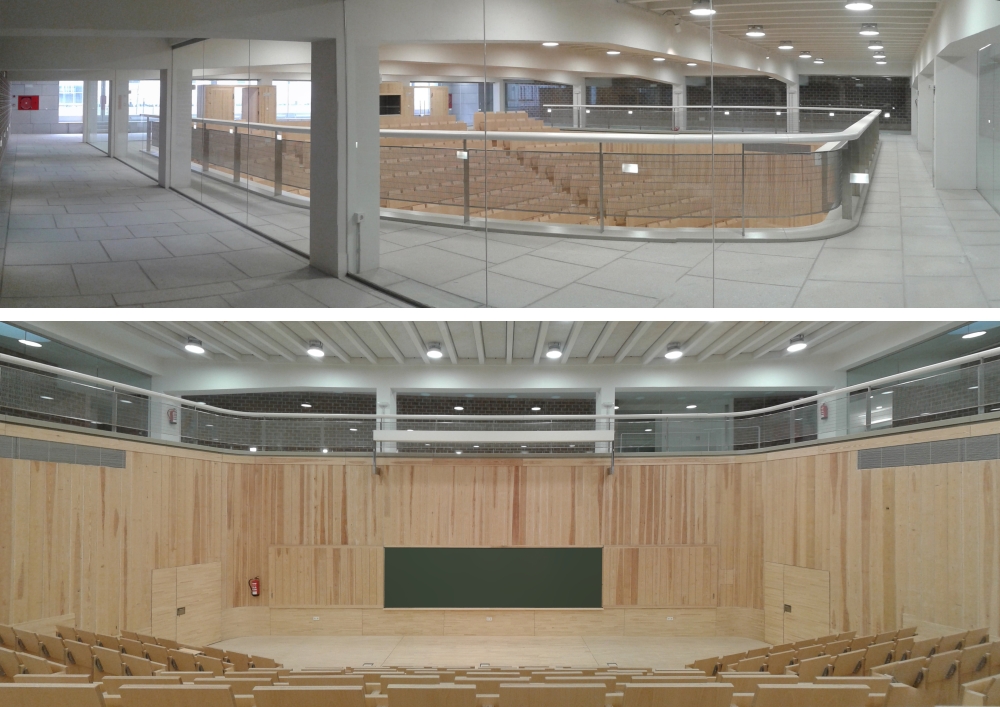
The Auditorium as central place of the school, express it's new visibility
-
One of the Drawing rooms that shows the construction of the recovered suitable spaces of the old Hospital for the new function
-
Site plan. The location of the new School of Architecture in the middle of the old district of Realejo, close to the Alhambra.
-
Ground floor as extension of the public space in its courtyards. The older and green courtyard with calm functions and the bigger for intensive activities
-
Main floor. In the central building, between the two courtyards, are situated the common activities: main entrance, lobby, secretariat, exhibition hall, main staircase, lifts...
-
The old, green courtyard and the bigger courtyard with the new auditorium. The tension, arising from what was authentic of the past and what has been added in the present, shapes the whole unit, thus finding at last an architectural destiny
-
The gallery, with it's wooden brise-soleil, is the only part of the construction arising as new volume. The control of light is an important issue of the intervention. Skylights in both sides of the courtyard iluminate the space of the auditorium
-
Evolution of the building, new arrangement of staircases and the central buiding as new connection between the two courtyards. The auditorium in the basement and de adjacent cafe have a direct access to the side street
-
The construction of the galleries is the only new visible volume of the intervention. The trees between the two levels of the courtyard and the brise-soleil are important elements for integration and architectural expresion, in balance with the old one
-
The axonometry shows the additive growth and the diversity of the different buildings.
-
Architecture School of Granada
Víctor López Cotelo. Granada, Spain
-
Name of work in English
Architecture School of Granada
-
Name of work in original language
Escuela Técnica Superior de Arquitectura de Granada
Prize year
EUmies Awards 2017
-
Work Location
Granada, Spain
-
Studio
Víctor López Cotelo
EUmies Awards 2017 Nominees




Collaborators
Program
Education
-
Labels
Architecture · University
Site area
5.01 m²
-
Client
Ministerio de Fomento. Universidad de Granada.
Total gross floor
13.785 m²
Completion
2015
Cost
880 €/m²
The current building structure went more than five hundred years all along through an extensive transformation process, the origin of which was a house from the Nazarí period. It continued in the XVIth century with the construction of the "Casa del Almirante". This process was gradually completed until the middle of the XXth century. The typological order, based on the double cloister convent, demands a physical articulation that allows integrating the new function. To attain this new unity it is necessary to carry out several interventions related to the historic conservation, the renovation and refurbishment of existing volumes, demolitions aside from new structures. The aim of the project has been to turn down the temporal dimension of the complex to zero, not in the sense of spurning the time of each part, but to make possible a fresh start of all parts together by means of the construction and the light.
The operation proposes a total refurbishment of the building, understanding this as VioletleDuc once wrote “to reinstate it in a condition of completeness which may never have existed at any given time”. In this complex, next to elements that have their own architectonic value, there were others that lacked it. What our intervention precisely aims at is that the tension, arising from what was authentic of the past and what has been added in the present, should shape the whole unit, thus finding at last an architectural destiny. In this new phase, construction will act as a catalyst agent of a new "unity" by acknowledging the materiality of each age and light as the integrating basis of the historical process. The program, adapted to the functional needs of the School, has been adjusted to the specific spatial, formal, and building features of the existing complex, finding a balance between the old spaces to be restored and the new intervention needed. The work is the direct result of this relationship between the new and the older structures, which are connected in terms of function and integrated following building criteria.
The materialization of the idea, is related on an equal basis with the existing elements, without yielding to the past but also without imposing on the new performance laws. It is precisely these elements, bare and without rhetoric, that are capable of bringing together the different periods which lead to the present time. Historic conservation and refurbishment have been carried out adjusting to the different cases. The new structures, depending on the type of existing construction, are almost made of one-way spanning concrete slabs, loading over pillars or walls. The main lecture theatre is built with 24 m. span post-stressed beams; the gable roofs with metal frames and, depending on its location, are covered with different roof tiles, flat roofs with zinc. Paving: granite, oak and rubber. Rendering: plaster or lime mortar in the walls. Cladding: Heraklith or plaster acoustic panels for ceilings, wood or soft wooden fibre panels in walls, and acoustic ceramic bricks. Solar protection in the new façades: pine wood brise-soleil, aluminium blinds and synthetic material awnings in the large skylights. Interior wood shutters and clap ventilation elements in windows.