-

View west from restored medieval fountain towards footbridge
-
West view of footbridge
-
Footbridge crossing Mersini stream
-
View from restored medieval cobbled path to fountain top (left) and footbridge
-
The footbridge width invites a moment of pause
-
Footbridge north end facing south, and stone retaining wall that offers seating
-
Topographic layout
-
Medieval fountain measured drawings
-
Cross section through fountain and west view of bridge
-
North elevation assemblage - medieval fountain and north bridge elevation
Architecture of Fleeting Memory - 2nd Phase Restoration of «Kato Vrysi»
Sevina Floridou Architect. Paphos, Cyprus
-
Name of work in English
Architecture of Fleeting Memory - 2nd Phase Restoration of «Kato Vrysi»
-
Name of work in original language
Αποκατάσταση μεσαιωνικής Κάτω Βρύσης Χούλους, ανασχεδιασμό προσβάσεων και κατασκευή πεζογέφυρας
Prize year
EUmies Awards 2026
-
Work Location
Paphos, Cyprus
-
Studio
Sevina Floridou Architect
EUmies Awards 2026 Nominees



A complex medieval irrigation node nestles beside Mersini stream, through a wooded gorge. It relates to a 14th c poem of Arodafnousa's ill-fated romance with King Peter I. Inscribed as UNESCO intangible heritage, the poem rekindled interest, restoring public access to the fountain via a footbridge.
Collaborators
Consultant structural engineer: Andros Achilleos - Hyperstatic Engineering Design; Archaeological supervision: Evie Fiouri - Department of Antiquities; specialised stone masonry: Argyris Panayiotou - Amfiaraos; Main building contractor: Dimitris Karpozilos - Karpozilos Ltd
Program
Landscape
-
Labels
Structure · Regeneration
Site area
435 m²
-
Client
Choulou Community Council (Christos Mitas and Petros Neofytides mayors)
Total gross floor
112 m²
Cost
1607 €/m²
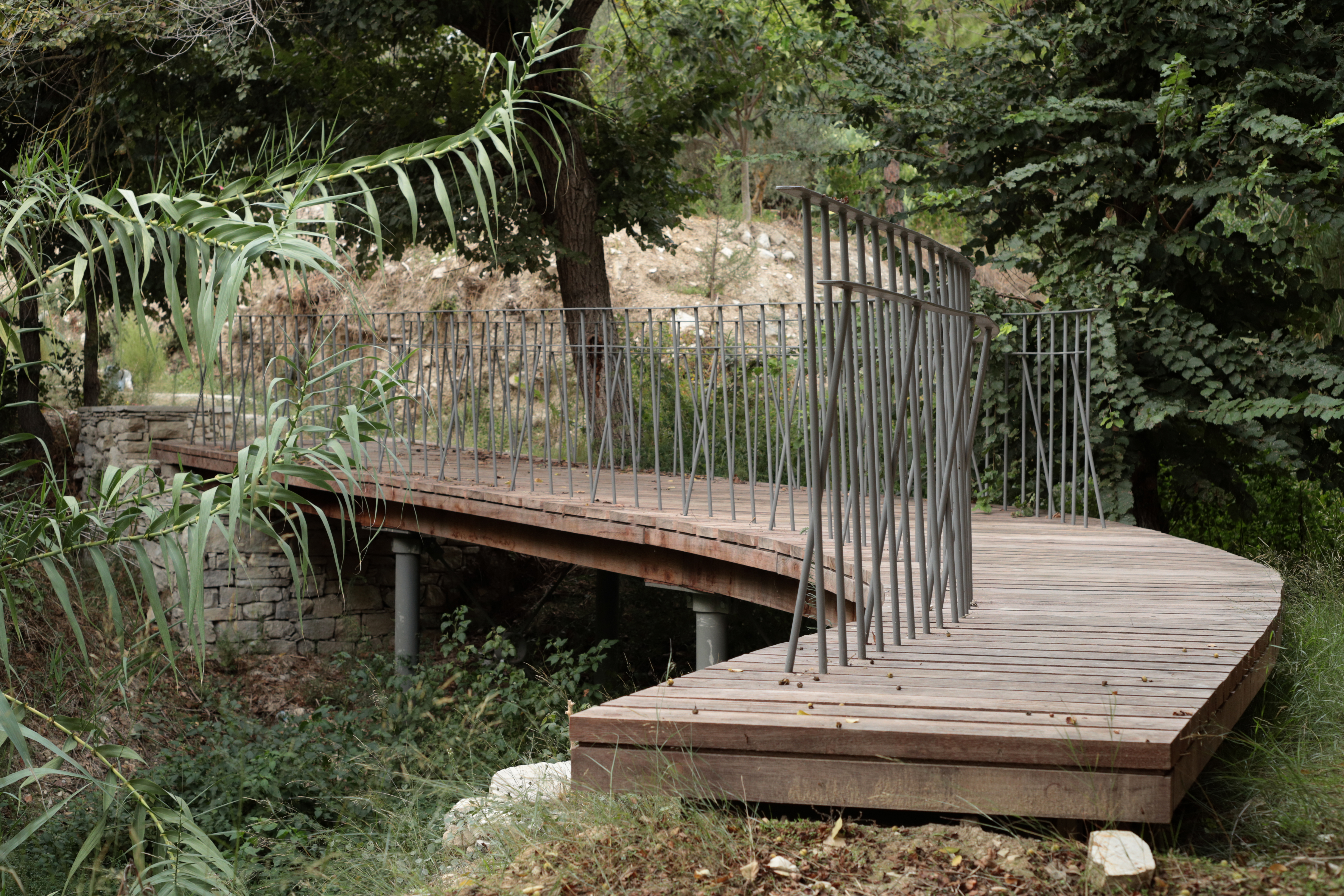
Of primary historic importance is the pointed-arched fountain (aedicula) of dressed sandstone, flanked by contrasting rusticated bedrock. It is accessed via a cobbled path with curved rock-cut steps on the west (for animals) and rough steps carved into the bedrock on the east side (for people). A new wood footbridge, on metal piles, crosses the stream, offering pause to enjoy the fragility of nature and architecture. The curved shape carefully follows existing contour lines, bedrock formations, and mature vegetation, joining two segments of medieval stone-cobbled paths leading to the fountain.
Re-imagining the communal narrative that gives the site its importance even today, historic significance and social complexity had to be meticulously re-assembled notionally before being identified in situ, since the location is naturally overgrown and any intervention must respect its wildlife significance. The method was to research scant written and oral sources and then reveal their tracings on the ground, linking the site to stories of medieval farming history, of water-sharing and basket weaving. Strict archaeological restoration of the medieval fountain was followed, with revelation of the step-by-step irrigation and basket-weaving pre-industrial significance of the site. At the same time, a contemporary approach was needed to re-insert lost accessiblity. Any new intervention had to also make the location appealing to locals and visitors. At the same time, any construction work had to be minimised since the location is of exceptional historic, natural and wildlife significance.
The project involves restoration, conservation, reconstruction and new insertion. The historic fountain was restored and conserved with stone and cured lime. Pre-industrial of rock-cut tracings were cleared and documented, paths were revealed, and conserved or restored using local stone and compressed earth. The footbridge deck is laid with diagonally cut Angelim pedra beams over a wooden truss, chosen for its durability, and low maintenance in both wet and dry environments suited to this microclimate. Structural support is provided by metal piers and piles. Concrete foundations were limited to the edges of the footbridge and concealed behind drystone supports. The construction method minimised earthworks, allowing nature to take over. A curved handrail diagonally supported along the footbridge, offers transparency, but also discretely accentuates a contemporary architectural presence. Maintenance is minimised to vegetation landscaping, path clearance and occasional earth compaction.