-

Representatice image.jpg
-
01.jpg
-
04.jpg
-
05.jpg
-
02.jpg
-
03.jpg
-
06.jpg
-
07.jpg
-
08.jpg
-
09.jpg
-
12.jpg
-
11.jpg
-
10.jpg
-
14.jpg
-
15.jpg
-
13.jpg
Architectural Composition as an Acknowledgement tool for Archaeology. The case study of Paestum Archaeological Park
Parastou Mollahosseinali. Paestum, Italy
-
Name of work in English
Architectural Composition as an Acknowledgement tool for Archaeology. The case study of Paestum Archaeological Park
-
Name of work in original language
La Composizione Architettonica come Strumento di Riconoscimento per l'Archeologia. Il caso studio del Parco Archeologico di Paestum
Prize year
Young Talent 2025
-
Work Location
Paestum, Italy
-
Author/s
Parastou Mollahosseinali
-
School
Architecture Department - University of Naples Federico II.
Naples, Italy
Young Talent 2025 YT Nominees




Architectural Composition as an Acknowledgement tool for Archaeology. The case study of Paestum Archaeological Park
Reinterpreting Lost Spaces: Architectural Composition as a Tool for Spatial Revival in Archaeological Parks
Program
Mixed use - Cultural & Social
-
Labels
Compact · Archaeology · Architecture · Heritage
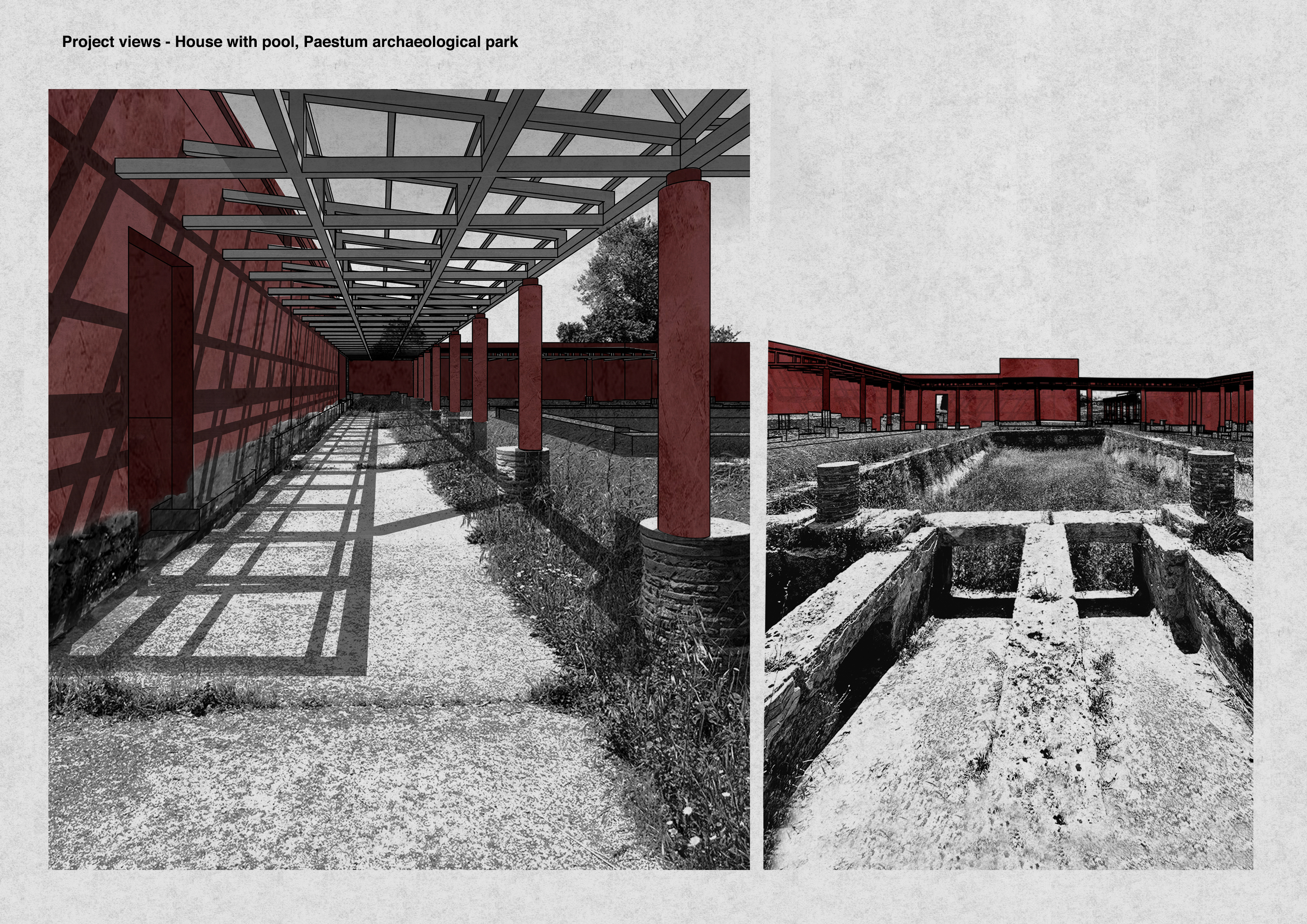
One of the main challenges in archaeological parks is the fragmented nature of spaces left after centuries of abandonment, which often leads to a lack of understanding for visitors, especially those without experience. This thesis addresses the issue by experimenting with architectural composition as a method to reintroduce the spatial conditions once present at these sites. The goal is to enhance visitors' understanding by reconstructing the original condition and spatiality of archaeological spaces, providing a clearer vision while preserving their authenticity and historical integrity.
Architecture acts as a crucial link between the past and the present, shaping both our understanding of ancient civilizations and our perception of their legacy. This project investigates the transformative role of architectural composition in enhancing the interpretability and preservation of archaeological sites, focusing on Paestum Archaeological Park, one of the world’s most significant examples of ancient Greek architecture in southern Italy. By positioning architectural composition as a mediator, the project proposes a framework that improves visitor comprehension and engagement with the site, while evoking the spatiality and atmospheric conditions of the past. It highlights the potential of positioning thoughtful compositions, to deepen the connection between visitors and the historical context of the ruins, mitigating misinterpretations and fostering a holistic experience. To fully understand the critical interventions needed to reflect the original conditions and spatiality in this thesis, a thorough analysis of the urban fabric established by the Greeks and later adapted by the Romans was conducted. The aim is to provide visitors with an immersive experience that allows them to perceive the original spatial conditions as they move through the site. This includes reintroducing visual connections that are currently lost due to the fragmented nature of the ruins, as well as conveying the height and scale of spaces through movement and spatial perception. The thesis argues that by engaging with these reconstructed spatial qualities, visitors can gain a deeper, more intuitive understanding of the site, enhancing their educational experience and fostering a stronger connection to its historical significance.