-

Entrance square
-
View towards the horizon
-
Farewell chapel atrium
-
Burial field
-
Burial fields from above
-
Space for scattering ashes
-
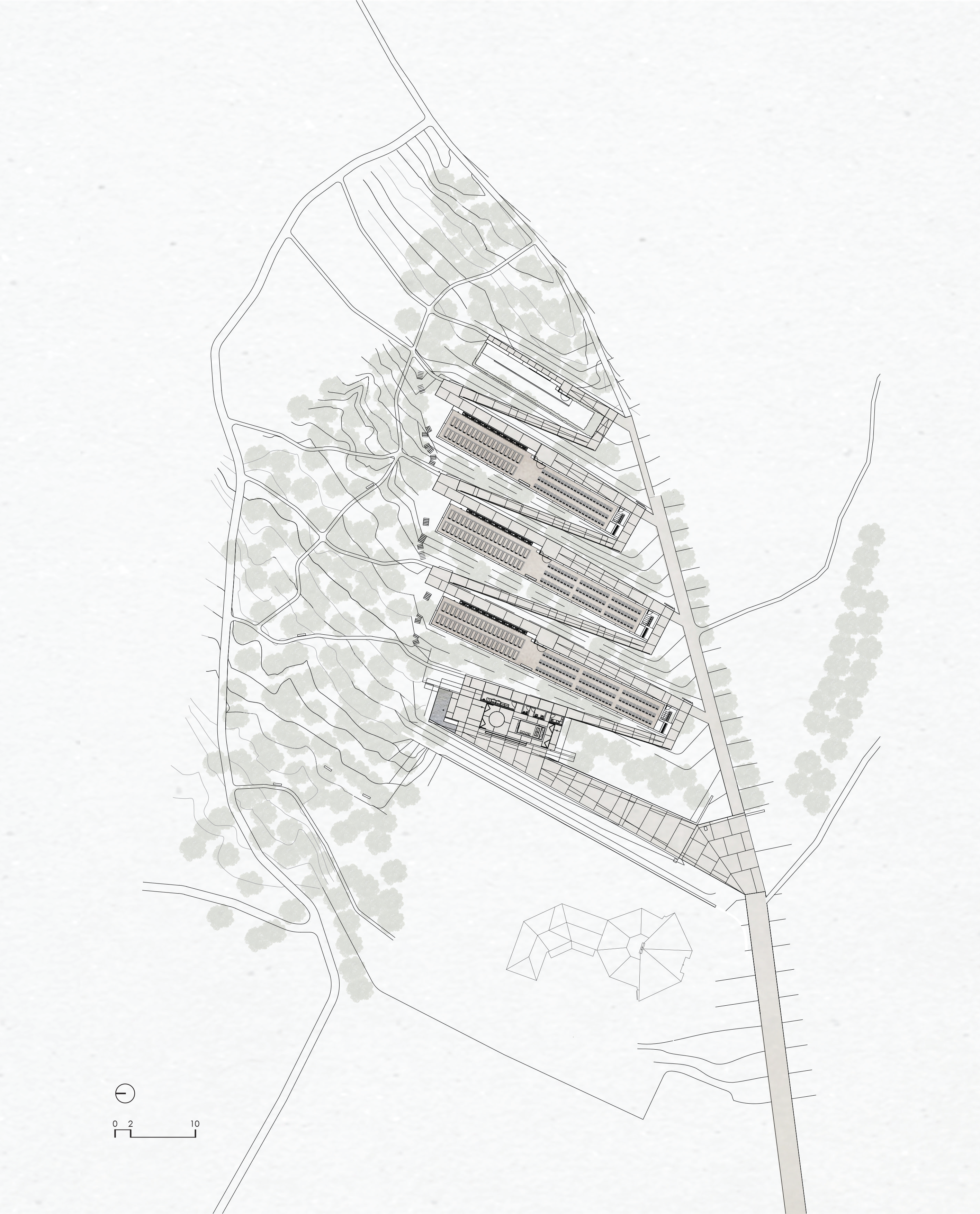
Site plan
-
Axonometry
-
Farewell chapel structural axonometry
-
Farewell chapel section
-
Burial field plan and sections
-
Space for scattering ashes plan and sections
Ankaran Cemetery
VOID arhitektura, Studio AKKA. Ankaran, Slovenia
-
Name of work in English
Ankaran Cemetery
-
Name of work in original language
Pokopališče Ankaran
Prize year
EUmies Awards 2026
-
Work Location
Ankaran, Slovenia
-
Studio
VOID arhitektura, Studio AKKA
EUmies Awards 2026 Nominees


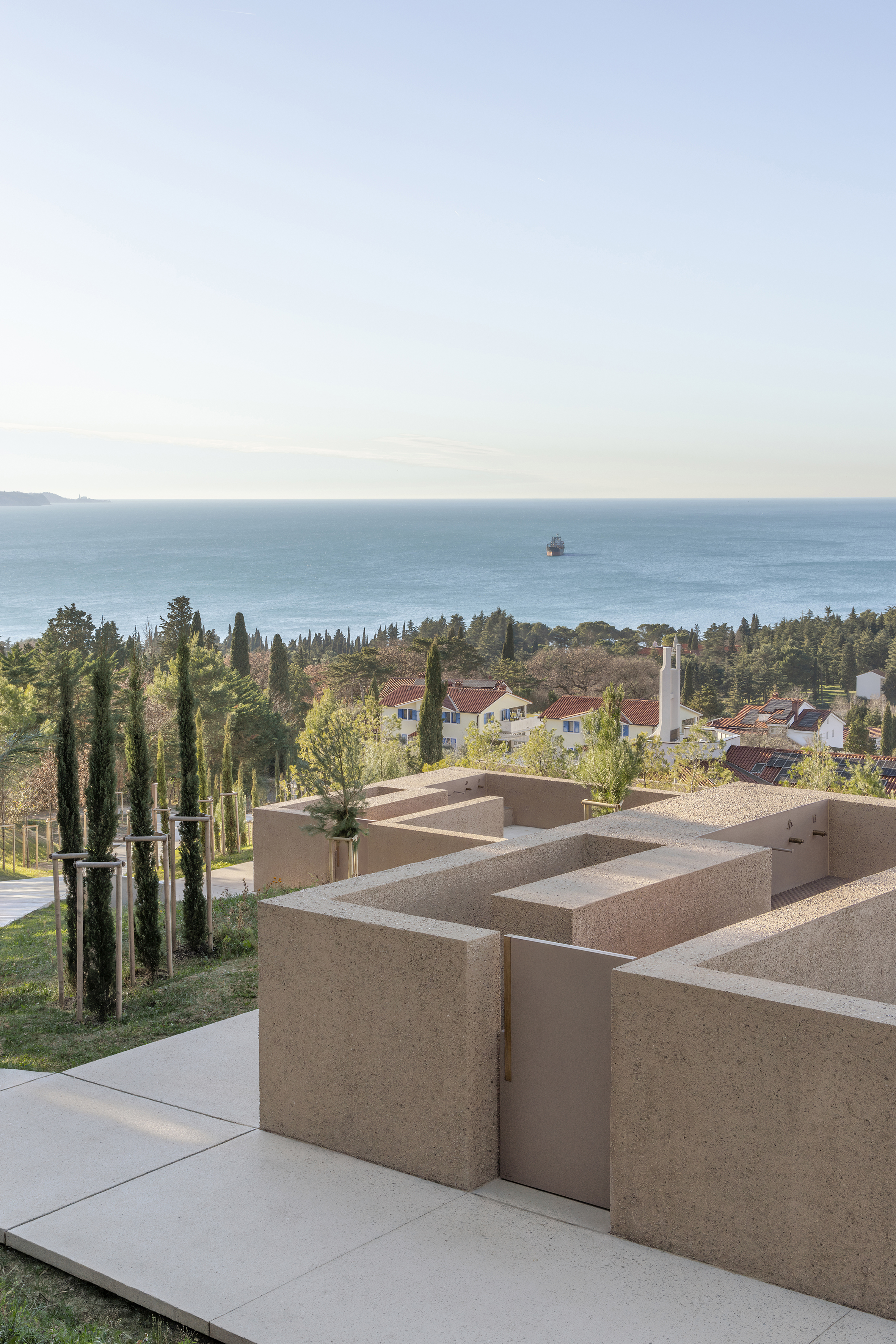



The Ankaran Cemetery with its contemporary approach to the cemetery as part of a free passable forest park accessible to all, transforms the traditional idea of the cemetery space as a place of the remembrance into a metaphor for community.
Collaborators
Wayfinding design: Tomaž Mlinarič - VOID arhitektura
Program
Funerary
-
Labels
Cemetery
Site area
7085 m²
-
Client
Municipality of Ankaran
Total gross floor
340 m²
Cost
450 €/m²
The Ankaran Cemetery is conceived as a liminal transition space between the verticalness of the adjacent forest and the limitlessness of the Adriatic horizon. The space of the cemetery is defined by contrasting transitions between open and closed, light and dark – between the here and the hereafter. On the one hand cemetery functions as a freely passable forest park intended for walks and contemplation, and on the other, as a series of marked burial fields—smaller cemeteries—which are aligned in terraces on the slope above the farewell building.
The cemetery is located on the ridge above Ankaran, from which it offers a spectacular view of the Adriatic Sea. It is precisely because of its exceptional location that the land was originally planned for commercial programs, but after protests by the local community it was re-purposed as a cemetery. Ankaran did not have a suitable place to say goodbye its deceased, therefore, both functionally and symbolically, the new cemetery defines one of the main public spaces for the community. The steep relief is therefore geometrized into five terraces. The farewell building is located on the first terrace and is accessible by a low ramp. Walled burial fields are located on the next three terraces, the highest of which serves as a space for scattering ashes. Smaller, more intimate ambient spaces are connected by a serpentine ritual path embedded in a network of forest paths. The path is where the process of mourning, remembering and reflecting, as well as socializing and meeting can occur.
Architectural elements materially derive from the colours and textures of the location. Amidst the massive washed concrete walls in the earthy colour of the flysch, the polished concrete urn walls stand out, while the bright ritual path floats above the terrain. The cemetery contains 110 ground coffin graves, 246 ground urn graves, 180 urn niches and an area for ash scattering. The farewell building is close to the forest’s edge and set aside from the building mass of the existing church, which enables unobstructed views of the horizon. The design of the burial fields is derived from the interpretation of traditional walled cemeteries. The burial fields are surrounded by a low wall, which is interrupted by a higher urn wall at the entrance. The dramaturgy of architectural and landscape elements directs the visitor’s gaze alternately along the terrain into the vertical forest and perpendicularly to the terrain towards the sea, into this unfathomable dimension that merges with the sky.