-

South façade with shutters open and closed
-
Exterior view
-
East exterior corridor
-
Façade with shutters open and closed
-
Double-height corridor on the ground floor.
-
Detail of interior shared spaces
-
Situation
-
Basements floors, ground floor, 1st floor
-
2nd floor, 3rd floor, 4th floor, attic floor, roof floor
-
Conceptual cross-section
-
Elevations
-
Detail construction plan. Façade and window
Alto Residencial Cooperativa
Manuel Carbajo Capeans | Celso Barrios Ceide (Carbajo y Barrios Arquitectos Asociados S.L.P.). Santiago de Compostela, Spain
-
Name of work in English
Alto Residencial Cooperativa
Prize year
EUmies Awards 2026
-
Work Location
Santiago de Compostela, Spain
-
Studio
Manuel Carbajo Capeans | Celso Barrios Ceide (Carbajo y Barrios Arquitectos Asociados S.L.P.)
EUmies Awards 2026 Nominees
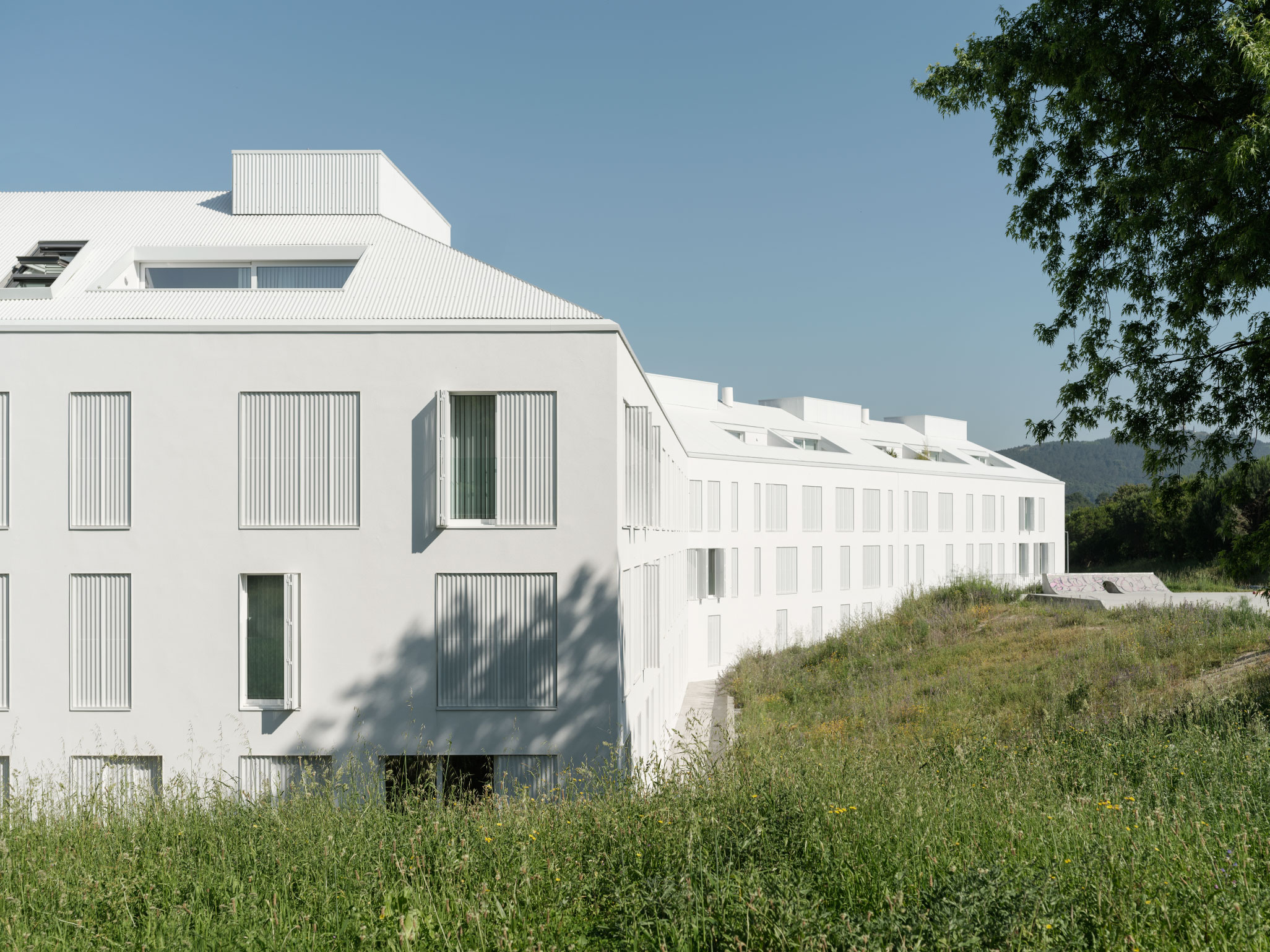


Housing cooperative building designed in response to the site's configuration: a linear, edge-defining volume articulated as a continuous mass with varied textures. Perforated sheet metal acts as filter between exterior and interior, while seamless white cladding ensures visual continuity.
Collaborators
Collaborator (office): Alejandro Calviño Pérez - Carbajo Barrios; Collaborator (office): David Camiño Quintela - Carbajo Barrios; Collaborator (office): Laura Pardo Ponte - Carbajo Barrios; Collaborator (office): Beatriz Asorey - Carbajo Barrios; Construction management: Enrique Martínez Carregal - Grupo Arial; Site Manager: Evaristo Mosteiro - Grupo Arial; Site Foreman: Santiago García - Grupo Arial; Site Foreman: Alberto Vieito - Grupo Arial; Signage design: Ricardo Tubío - Cenlitros; Signage design: Xabier Rilo - Cenlitros; Installations: Carmelo Freire Beiro - Obradoiro Enxeñeiros; Structure: Ismael Ameneiros - Ameneiros Rey HH Arquitectos; Structure: Santiago Rey - Ameneiros Rey HH Arquitectos; Photography: Luis Díaz Díaz
Program
Collective housing
-
Labels
Linear block · Social
Site area
1402 m²
-
Client
Alto Residencial Sociedade Cooperativa Galega
Total gross floor
7904 m²
Cost
614 €/m²
A 34-unit residential building developed as a cooperative in Santiago de Compostela. The design responds to the site's configuration through a linear, edge-defining volume articulated as a continuous mass. Its envelope features contrasting textures: perforated sheet metal associated with the openings, acting as a transitional element between exterior and interior, and a solid surface finished with seamless white cladding. The composition is crowned by a sloping roof that reinforces the typological identity of the complex and is materialised in harmony with the cladding of the façade openings.
The main challenge was to integrate 34 dwellings into an irregular, linearly shaped plot with a steep transverse slope. This condition transformed the resulting building into a retaining structure that mediates between different levels of the surrounding public space. Volumetrically, the building reflects the site’s configuration materialised as a continuous volume topped with a three-gable roof that reinforces the typological identity of the complex. Access to all dwellings is provided through a single entrance from the street, leading into a spacious double-height corridor that consolidates circulation routes. This central space functions as a shared lobby for five internal communication cores and connects to the community room located at the far end, which also has independent access to the public space on the opposite side of the plot. Except for the underground levels, the entire building is dedicated to housing, distributed across single-level and duplex units.
The project incorporates an active façade system based on ETICS, integrating folding shutters that allow the envelope to adapt to varying climatic conditions. This strategy enables passive solar gain in winter by harnessing solar radiation, while in summer it limits direct sunlight, reducing overheating. The shutters thus become both a distinctive architectural feature and an effective passive control element. Thermal conditioning is provided by a geothermal heat exchanger combined with underfloor heating, ensuring high seasonal efficiency and low energy demand, which translates into reduced conventional energy consumption and associated emissions. Most dwellings benefit from natural east-west cross ventilation; in units where this is not possible, a dual-flow mechanical ventilation system with heat recovery has been installed. The combination of passive and active strategies contributes to the building’s high energy performance.