-

Web Gallery 1_Marcela Percu.jpg
-
Web Gallery 2_Marcela Percu.jpg
-
Web Gallery 3_Marcela Percu.jpg
-
Web Gallery 4_Marcela Percu.jpg
-
Web Gallery 5_Marcela Percu.jpg
-
Web Gallery 6_Marcela Percu.jpg
-
Web Gallery 7_Marcela Percu.jpg
-
Web Gallery 8 _Marcela Percu.jpg
-
Web Gallery 9_Marcela Percu.jpg
-
Web Gallery 10_Marcela Percu.jpg
Along the banks of Via de Cintura Interna: A regenerative proposal for Porto's urban fabric
Marcela Percú de Oliveira Solon Ribeiro. Porto, Portugal
-
Name of work in English
Along the banks of Via de Cintura Interna: A regenerative proposal for Porto's urban fabric
-
Name of work in original language
Pelas margens da Via de Cintura Interna: Uma proposta regenerativa para o tecido urbano do Porto
Prize year
Young Talent 2025
-
Work Location
Porto, Portugal
-
Author/s
Marcela Percú de Oliveira Solon Ribeiro
-
School
Faculty of Architecture - University of Porto.
Porto, Portugal
Young Talent 2025 YT Nominees


Along the banks of Via de Cintura Interna: A regenerative proposal for Porto's urban fabric
Pelas margens da Via de Cintura Interna: Uma proposta regenerativa para o tecido urbano do Porto
Program
Urban planning
-
Labels
Master plan · Public Space · Redevelopment · Heritage
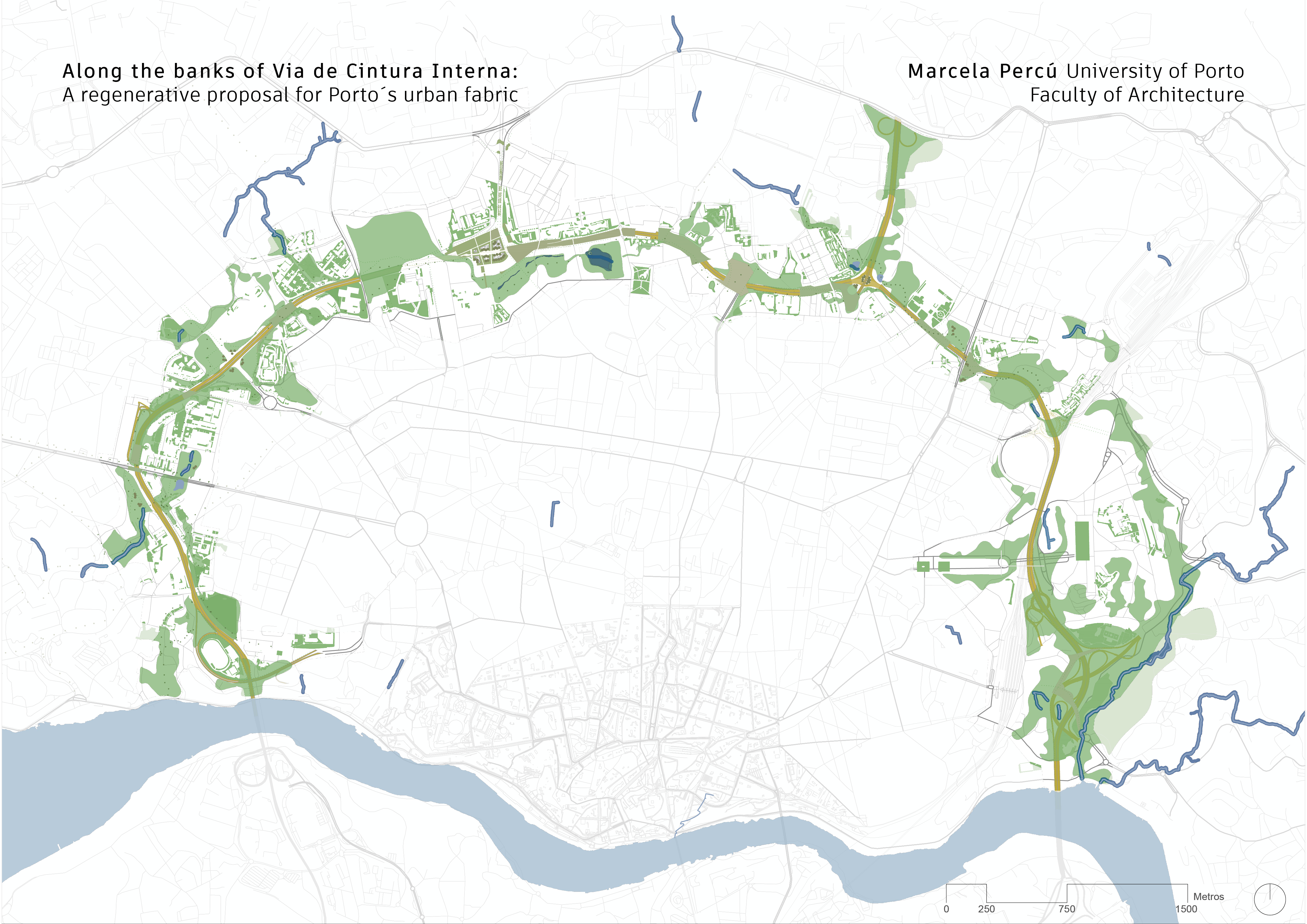
Porto’s Via de Cintura Interna is a urban highway that, paradoxically, both integrates and radically ruptures the urban and social fabric. The urban and environmental impact of this road affects an extensive zone along its banks, also jeopardizing decarbonization goals. Given the urgency in promoting more sustainable cities, it’s essencial to change its role in both local and territorial scales, with changes in urban policies and a transition from individual motorized transportation to collective and active mobility alternatives.
This proposal aims to restore urban quality and street life, overcoming the primacy of cars and recovering pedestrian space. Instead of the highway, it is now the surrounding green and blue system that takes the structuring role for a network of sustainable mobility and public spaces, articulating old and new centralities and reconecting neighbourhoods and comunities. The strategy is implemented in phases, and at the macro, medium and micro scales. The two lines of action focus on the VCI itself and, most importantly, on its margins. Goals of the first phase include slowing traffic, promoting public and active mobility, the creation of new parks and recovering historical paths. This will drive a gradual change in the character of the VCI, from highway to an urban avenue. Later phases include more extensive and expensive interventions, such as green coverages, a tunnel and the redesign of road intersections. The intersections were redesigned to turn useless spaces into more housing, public equipments and intermodal points, which also take up a metropolitan role. The creation of an urban park has a central function in restoring the existing greenbelt, creating healthy public spaces and a diverse ecological mobility network associated to walkways and historical paths. The implementation of sustainable mobility plans is urgent to update the demands and new means of travel in the 21st century, ensuring everyone´s right to the city. Our interventions in multiple scales aim to regenerate urban and social fabric, promoting a more cohesive, inclusive and resilient territory.