-

Cover Image.jpg
-
Graphic Document 1 - Urgency.jpg
-
Graphic Document 2 - Terrible & Beautiful.jpg
-
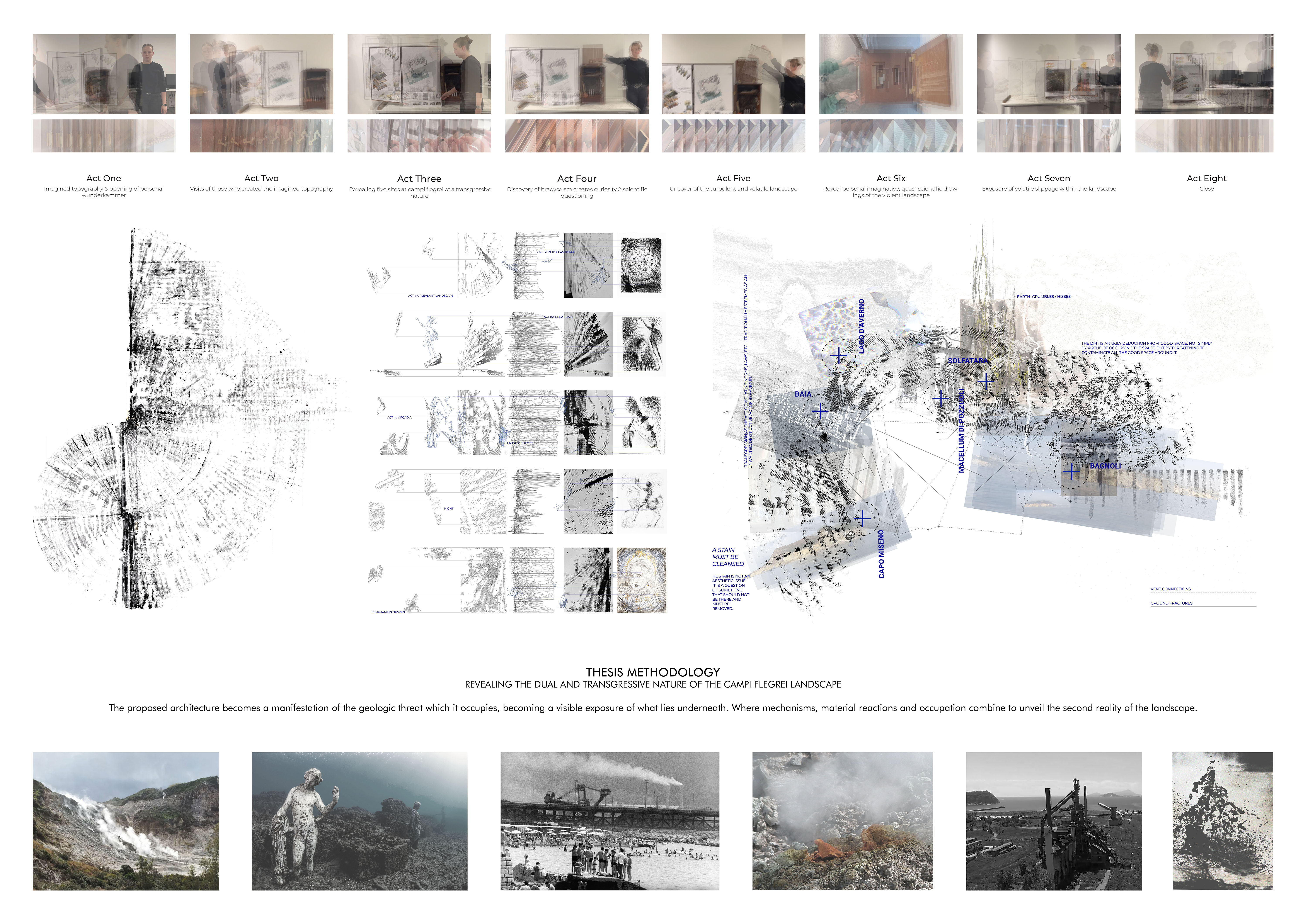
Graphic Document 3 - Methodology.jpg
-
Graphic Document 4 -Festival of Extinction.jpg
-
Graphic Document 5 - The Crisis Salon.jpg
-
Graphic Document 6 - The Growth Hub & Rare Earth's Refinery.jpg
-
Graphic Document 7 - The Soil Remediation Living Archive.jpg
-
Graphic Document 8 - The Cartographer's Watchhouse.jpg
-
Graphic Document 9 - The Cartographer's Watchhouse Interior.jpg
-
Graphic Document 10 - The Echo Chamber.jpg
-
Graphic Document 11 - The Sulphur Pulpit.jpg
Against Extinction
Aoife Marie O'Connor, Aleksandra Polak. Pozzuoli, Italy
-
Name of work in English
Against Extinction
-
Name of work in original language
Seeking Redemption in the Gulf of Pozzuoli
Prize year
Young Talent 2025
-
Work Location
Pozzuoli, Italy
-
Author/s
Aoife Marie O'Connor, Aleksandra Polak
-
School
School of Engineering and Architecture, SEFS - University College Cork & Munster Technological University.
Cork, Ireland
Young Talent 2025 YT Nominees




Against Extinction
Seeking Redemption in the Gulf of Pozzuoli
Program
Mixed use - Cultural & Social
-
Labels
Aggregation · Archives · Community · Architecture
This architecture queries our economic system that destabilises the climate that humanity relies on and offers progress in return. Built of the volcanic landscape the project manifests the threat below to offer a redemption that reactivates the Gulf of Pozzuoli from its ruined past to offer future spaces that prevent loss of culturally significant information. As users are surrounded by the potential volcanic power and interact with stories of climate victims, the architecture highlights societies proximity to extinction. It encourages the users to query the threat of our collective actions.
The Festival of Extinction works on behalf of climate victims to archive at risk cultural information and practices while encouraging a change in behaviours. Occupying four sites across the hidden Campi Flegrei magma chamber, the Festival of Extinction gives the Gulf of Pozzuoli a new future focused narrative, while also directly mapping the scale of the volcanic threat. In contact with land that holds such potential, one’s own temporality is called to the forefront as ruins of past civilisations, toxic soil, and shifting land, places the visitor in proximity to peril. As the structures express the individual terrains faults, they become an extension of the violent landscape. The Gulf becomes a living crisis archive that queries how human actions are accelerating the process of extinction and landscape destruction. The volcanic threat is architecturally integrated in Miseno, Solfatara, Baia but in Bagnoli, proactive architecture remediates industrial damage that marks the Anthropogenic impact on the picturesque landscape. The festival ends on a final meal that enables true productive cooperation in order to slow societal acceleration towards extinction. The Festival of Extinction uses this turbulent geology to show visitors what the future holds if we do not act on the climate emergency. A future of angered landscapes, where poisoned land threatens back, is promised if change is not made. Goethe’s Faust is a literary shadow to the architecture as by striving for better we can be redeemed. Working with individual site conditions, architecture can become an expression of the earth’s voice as we shift the understanding of the earth as an object that is acted upon to a subject, that is worked with. Through this, we as a society can find redemption.