-

The character of the church as a free-standing typology was preserved in the adaptation.
-
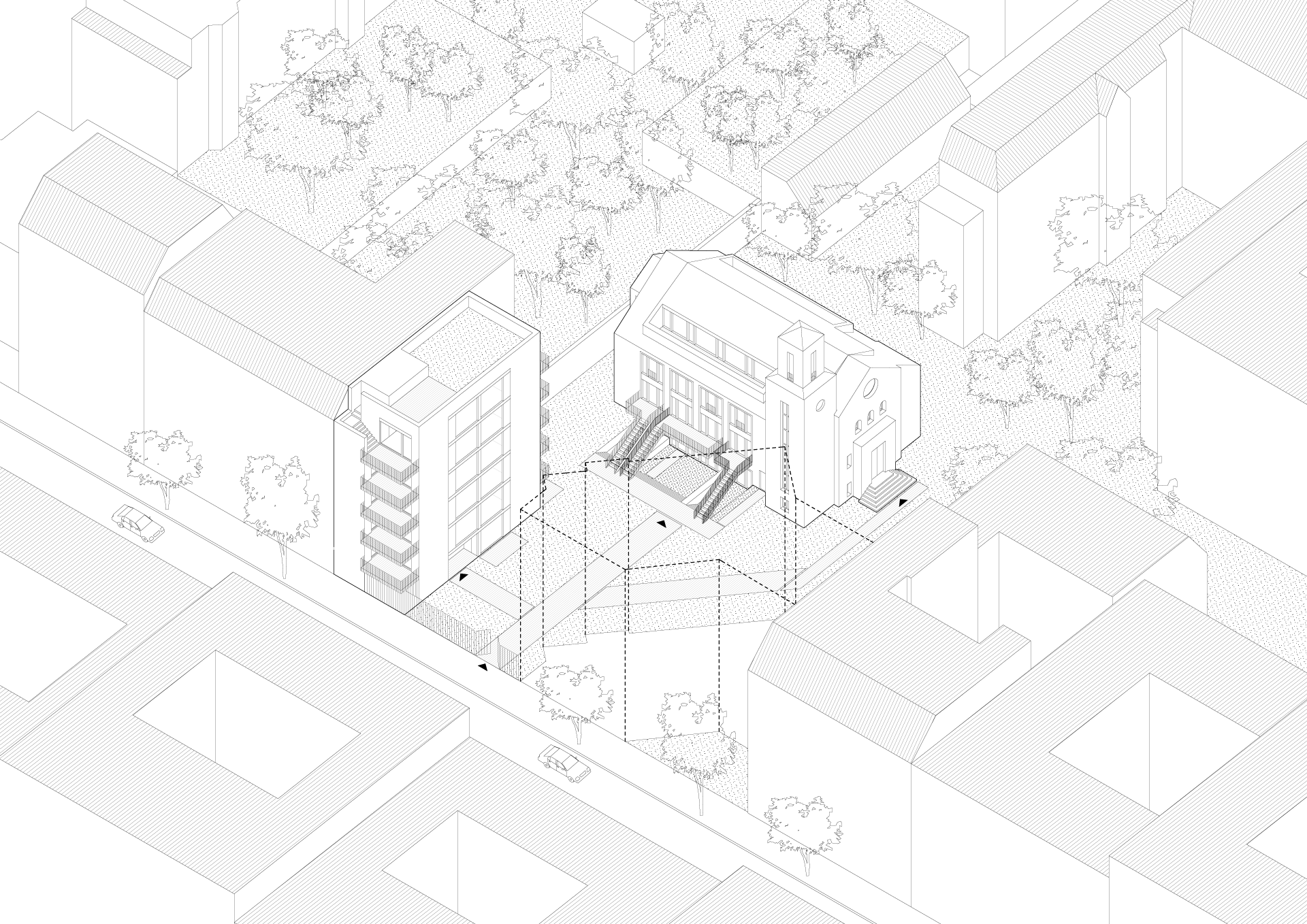
New metal stairs provide direct garden access to all units in the former Nave of the church
-
Architectural features of the church are seamlessly integrated into the spatial experience.
-
The belfry is reinterpreted as a dramatic entrance space to the top floor unit.
-
Double-height spaces are reminiscent of the former nave space
-
The church building remains the urban focal point, while adapted entrances hint at new functions
-
ground floor in context
-
1st floor in context (raised main floor in church)
-
2nd floor in context
-
3rd floor in context (top floor in church)
-
section
-
Axo of the ensemble
Adaptive Re-Use of a Church to Co-op Housing
Bundschuh Architekten. Berlin, Germany
-
Name of work in English
Adaptive Re-Use of a Church to Co-op Housing
-
Name of work in original language
Unnutzung einer Kirche zu Wohnungen
Prize year
EUmies Awards 2026
-
Work Location
Berlin, Germany
-
Studio
Bundschuh Architekten
EUmies Awards 2026 Nominees
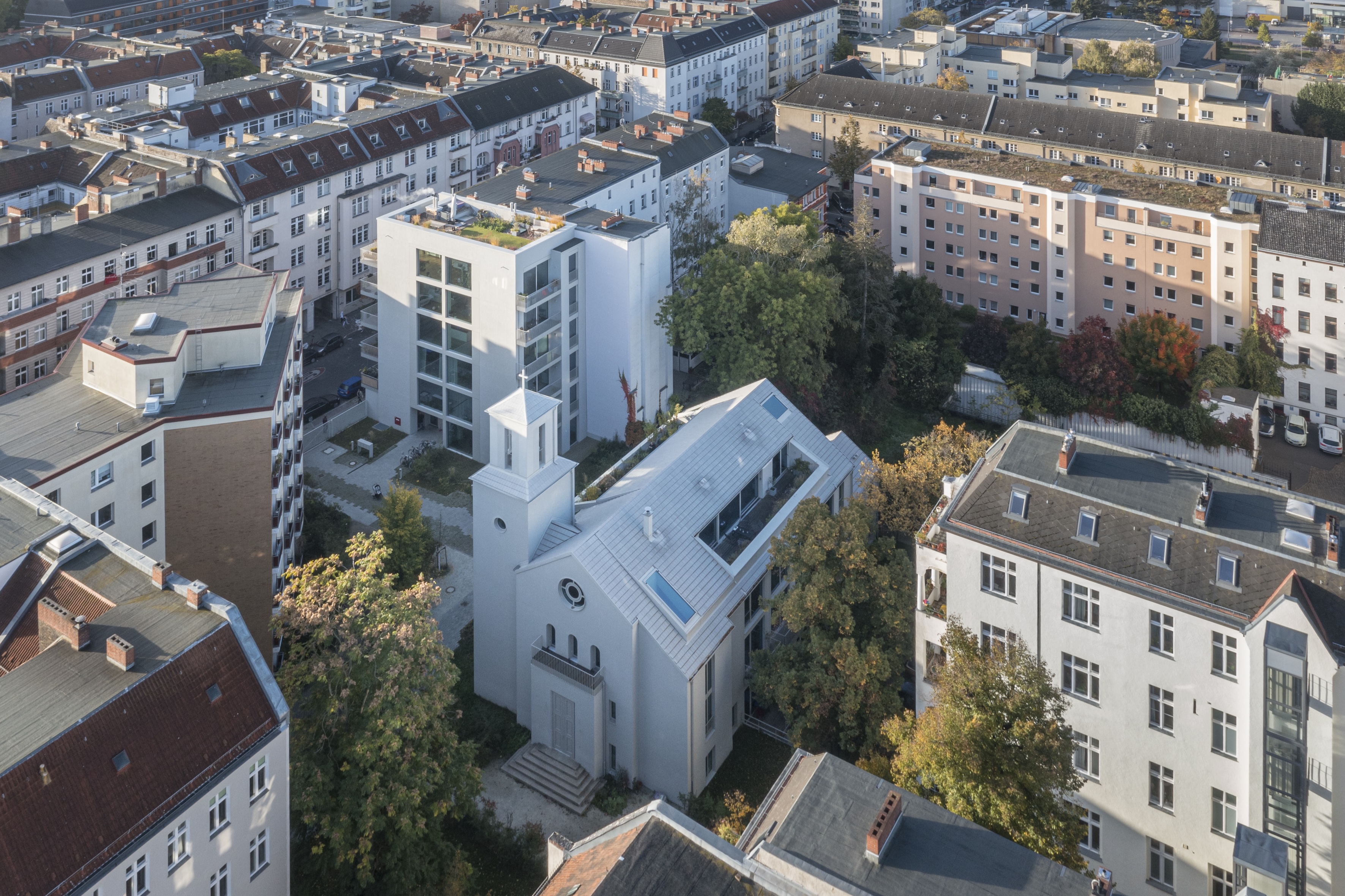


This adaptive re-use project is a conversion of an early 20th century church into 8 residential units. Set in an inner-city area of Berlin, the project preserves the major spatial and typological characteristics of the church and reinterprets them into (family-) living units of high specificity.
Collaborators
Structure: Neubauer + Ernst; Construction management: TEC Bauingenieure; Installations: Energiebüro; Project management: Bürgerstadt AG; Landscape: Hahn, Hertling, von Hantelmann; Fire Safety and Accessibility: Dr. Zauft; Collaborator (office): Ignacio Boscolo - Bundschuh; Collaborator (office): Phillipp Ockert - Bundschuh; Collaborator (office): Matthias Rothhaar - Bundschuh; Collaborator (office): Giulia Albarello - Bundschuh
Program
Collective housing
-
Labels
Infill · Elderly · Social · Youth
Site area
1933 m²
-
Client
Baugruppe Feurigstr. 21
Total gross floor
1439 m²
The (non-listed) methodist church in the inner-city area of Berlin-Schoeneberg was originally built in 1928, after destruction in WWII it was rebuilt in the 1950's. As the congregation grew smaller, the building became obsolete. Initiated by the architects, a building group was formed and the church with its surrounding garden cooperatively developed into a total of 14 residential units. 8 Units are in the church itself, while 6 new apartments are in a new building which frames the garden and its focal point, the church, on the urban scale.
The primary challenge was in translating the secularization of society into architectural spaces and atmospheres. In a church, everything revolves around religion and the veneration of a supernatural being, or idea. In this church, as in so many others, this took the place of strictly hierarchical and axially linear spaces and sequences. The new uses differ strongly: Instead of being collectively subordinate to a higher being, users follow very individual agendas and lives, they meet on equal terms; instead of being hierarchically focused on the cross, they communicate freely in a heterarchically organized community. Overcoming this contradiction in the spatial requirements is certainly the special feature of this task. Together with the individual tenants, we embraced the specificity of the church typology fully and adopted a playful adaptation of the various highly unique spaces into living units of equally high specificity. At the same time, it was vital to respect and cherish the ecclesiastical past of the building.
The choice of materials for this project was strongly influenced by the existing materiality. We deliberately didn't want to create a "counterpoint" to the existing structure in terms of materials; on the contrary: Where possible, we tried to work with it, rather than against it. New parts continue the narrative of the existing structure, rather than loudly proclaim their newness and individuality. Primary, monolithic and load-bearing materials therefore abound, i.e. masonry walls with stucco, wood windows, steel stairs and railings as well as exposed wood floors. A consistent color scheme played a key role in the interplay with the new building. A strictly monochromatic color scheme for all exterior surfaces of both buildings emphasizes the unity of the two components and underscores their shared character. For example, the new roof tiles were not chosen in the red of the period when they were built, but rather clay roof tiles were glazed in the project color.