-

Manifest
-
Urban analysis
-
Realization process
-
Masterplan, elevations and views
-
Urban corridor / Perspective section
-
Perspective cross sections / Room modules
-
Model
-
Across the Kresty / Panel
-
Across the Kresty
MARTINA SEEBERGER, RACHELE CASON, ANDREA CANCIAN. Saint Petersburg, Russia
-
Name of work in English
Across the Kresty
-
Name of work in original language
to generate new peripheral centers?
Prize year
Young Talent 2020
-
Work Location
Saint Petersburg, Russia
-
Author/s
MARTINA SEEBERGER, RACHELE CASON, ANDREA CANCIAN
-
School
Department of Architecture and Arts - IUAV University of Venice.
Venice, Italy
Young Talent 2020 YT Nominees


Across the Kresty
to generate new peripheral centers?
Program
Mixed use - Cultural & Social
-
Labels
Aggregation · Library · Sports Centre · Theatre · University
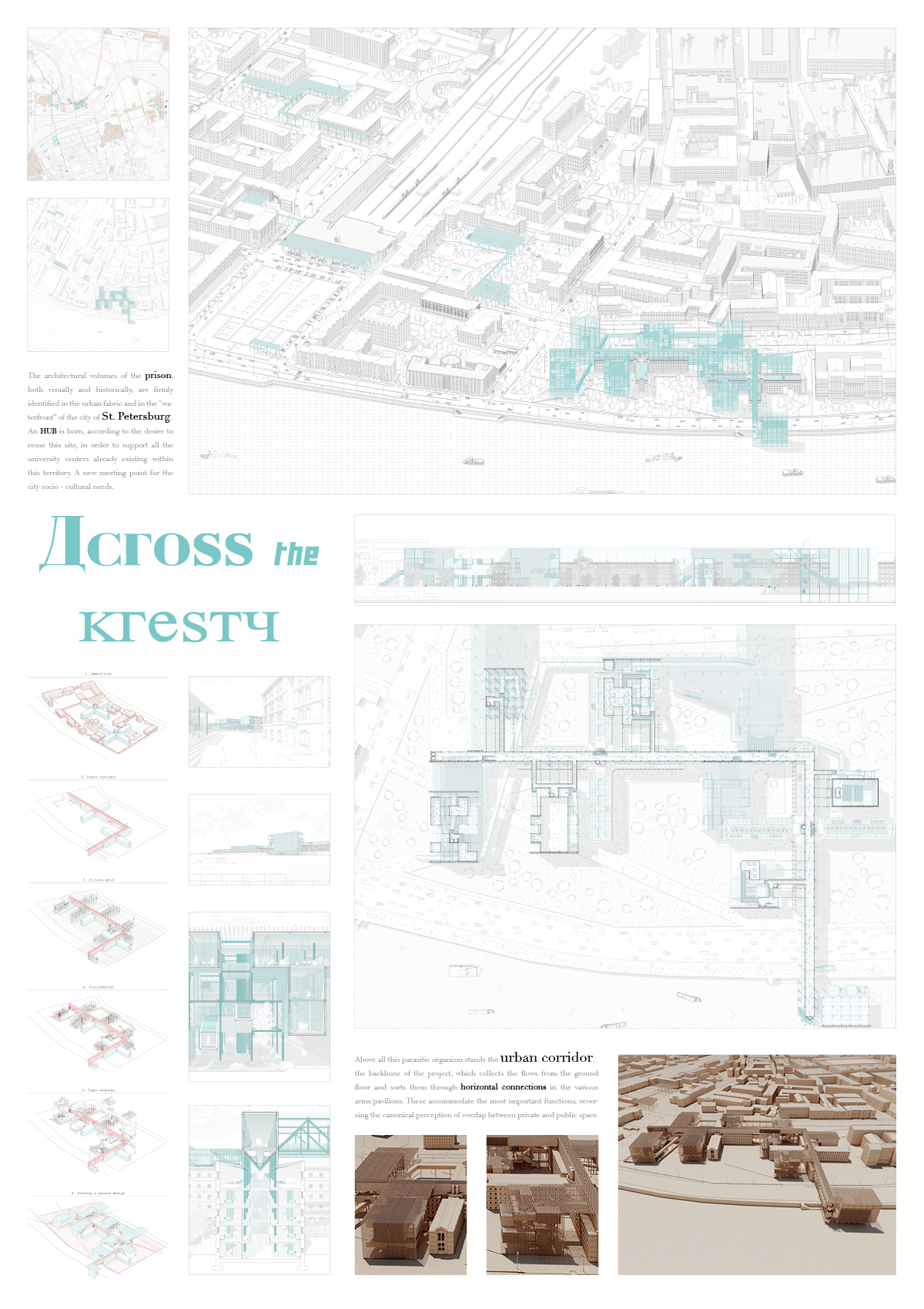
Why reuse prisons rather than starting from scratch? The architectural characteristics of the prison typology, or else the fact that these structures are designed to last over time, permits a projectual approach aimed at reuse. Cities around the world have just begun to discover their potential.?
The architectural volumes of the prison are firmly identified in the urban fabric and in the waterfront of the city of St. Petersburg both visually and historically. The possibility of reusing rather than a total “tabula rasa" seemed to us the best option to enhance such a potentially interesting space. By paying particular attention to the salient points from the area, such as the strong “caesura” imposed by the Neva river, the total absence of adjacent green public spaces and the proximity of industrial areas, we wanted to create a new form of settlement useful to the city.\nThe first approach was dedicated to guiding the flows towards the Kresty, so a series of shading covers were designed to act as an architectural compass. This system of “lamellae” finishes by covering the entire architectural factory ending in a unitary curtain on the south side of the structure\nAbove all this parasitic organism stands the urban corridor, the backbone of the project, which collects the flows from the ground floor and sorts them through horizontal connections in the various arms/pavilions, which accommodate the most important functions. In fact, reversing the canonical perception of overlap between private and public space, we have adopted a development of the functions in a descending way (from the urban corridor downwards) thus freeing the ground floor from any obstructions, ensuring total permeability of the area not only for the flows but also to the multiple road/urban routes that find their connection point in the Kresty.\nThe functions within the parasitic organism have been developed in two different ways: if externally the urban corridor evolves into a modular arrangement of cubes, embedded in a mesh of pillars and steel beams, which host all the cultural and social functions; on the other hand inside the prison, it dematerializes leaving only the supporting structure on the ground. The cells, which once housed thousands of prisoners, have been rethought to accommodate hundreds of students, thus transforming an old abandoned prison into its exact opposite: a new beating heart, home to freedom and youth.