-

Maison Commune, Pantin (France)
-
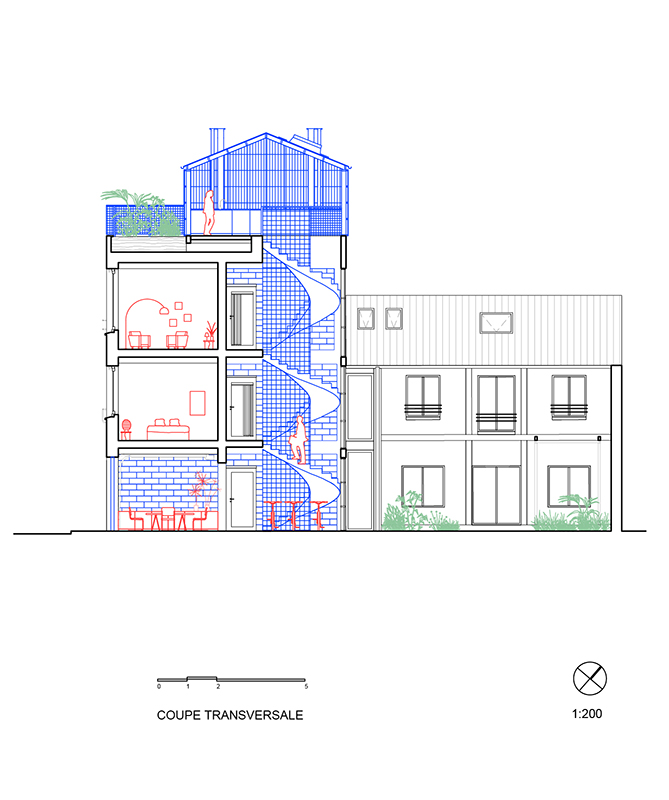
Maison Commune, Access Hall / The hall has an infrastructural character (leaving space for bikes and trolleys), connected with the inner courtyard and existing house.
-
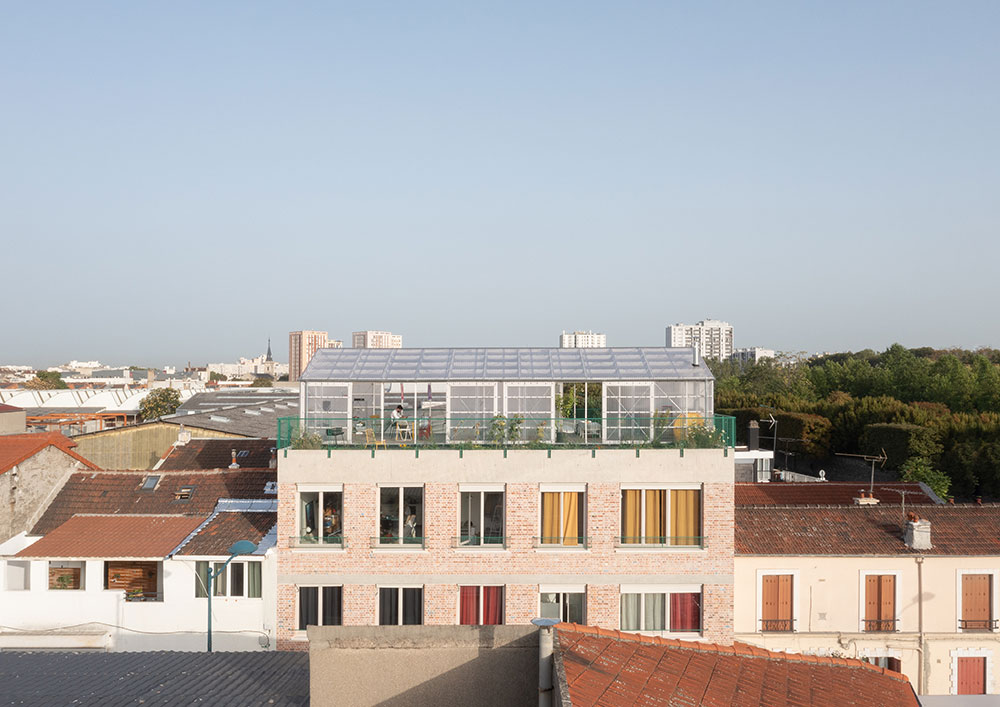
The system of commons is crowned by a generous greenhouse (integrating a communal kitchen and laundry) and a terrace with privileged views towards the surroundings.
-
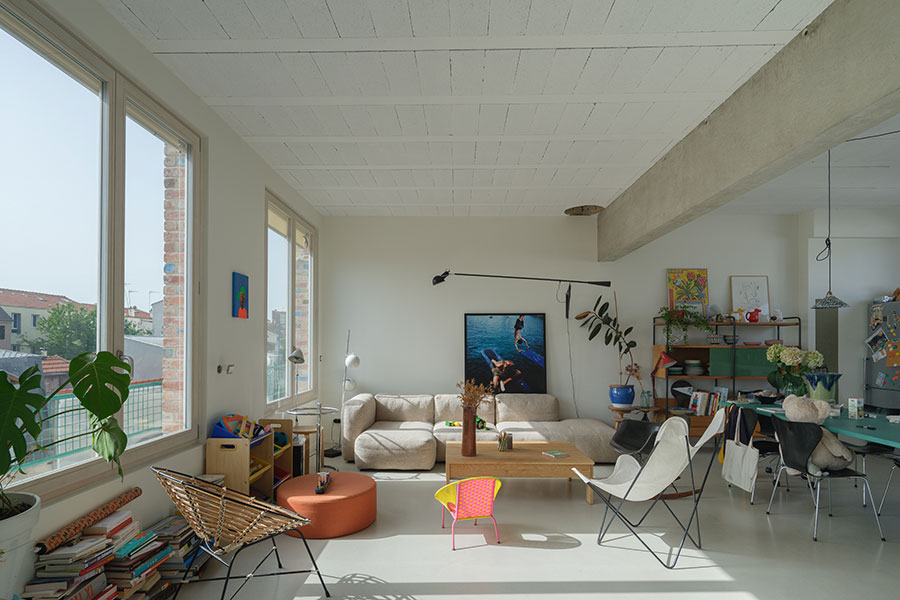
Maison Commune, Apartment
-
Maison Commune, Shared Greenhouse and terrace
-
The unique charm of this low density residential neighbourhood, closely surrounded by industrial buildings, dwells in the loose closeness to the city that surrounds it.
-
Maison Commune, Ground floor
-
Doors for accessing apartments are translucent, bringing light and depth to the interiors and extending the domestic life to the circulation.
-
The vertical commons has its own identity: a concrete stairs casted on site is then enclosed by a light polycarbonate layer, thus expressing a cut-out in the facade towards the courtyard.
-
Maison Commune, Elevation
-
Maison Commune, Shared Greenhouse on the roof
-
Maison Commune, Sequence of commons from the city to the courtyard and rooftop.
-
Maison Commune, Main facade towards the street.
-
A2 Panel / Maison Commune
-
A common house
Plan Común. Pantin, France
-
Name of work in English
A common house
-
Name of work in original language
Maison Commune
Prize year
EUmies Awards 2024
-
Work Location
Pantin, France
-
Studio
Plan Común
EUmies Awards 2024 Nominees






Collaborators
Program
Collective housing
-
Labels
Courtyard · Compact
Site area
255 m²
-
Client
SCI Jack Co.
Total gross floor
433 m²
Completion
2023
1. Towards self-commission. To design our own briefs has been key in the past and fundamental for the future of our practice. On this, Maison Commune is a specific model to learn from : we were able to design the brief from the very beginning, leading the administrative, financial and architectural studies and processes. Taking such responsibilities directly benefited the project. It allowed us to keep a good level of autonomy and openness when taking fundamental spatial and material decisions. 2. Site specificity and charm. The plot of 15m x 17m is located next to the Parisian Cemetery of Pantin (an ignored metropolitan garden of 107 hectares) and included a two-floor L-shape worker’s house. The unique charm of this low density residential neighbourhood, closely surrounded by industrial buildings, dwells in the loose closeness to the city that surrounds it. 3. Open Design Process. The initial project was an extension of the existing house towards the street. This option was discarded during the studies after confirming the fragility of the ground and existing structure. In the end we decided to demolish the volume towards the street (60% of the whole existing building), to provide a resistant new frame. The value of pre-existences needs to be confirmed case by case.
4. Form follows attitude. Although the urban regulations allowed us to build 4 floors, we decided to build only 3. By doing so, we avoided blocking the sunlight to neighbours and at the same time, to introduce a covered shared space on the rooftop. In other words, building less private space, but ensuring generous spaces of encounter for the inhabitants. 5. Commons in sequence. The ratio between domestic spaces (336,7 m²) and collective spaces (230,2 m²) is exemplary. A sequence of shared and non-heated spaces integrates accesses in all levels. The hall has an infrastructural character (leaving space for bikes and trolleys), connected with the inner courtyard and existing house. The vertical commons has its own identity: a concrete stairs casted on site is then enclosed by a light polycarbonate layer, thus expressing a cut-out in the facade towards the courtyard. Doors for accessing apartments are translucent, bringing light and depth to the interiors and extending the domestic life to the circulation. The system of commons is crowned by a generous greenhouse (integrating a communal kitchen and laundry) and a terrace with privileged views towards the surroundings.
6. Simplicity, always. The project is defined by a strong simplicity in the building site. A rational concrete skeleton (pillars & beams) of three floors is easily completed by prefabricated concrete slabs and masonry. A common sensical choreography avoiding useless complexity. 7. Re-use at the scale of the building. Reclaimed bricks were found and cleaned in Belgium (less than 300km of distance, reducing even more the carbon footprint) and then tested in France. Towards the street bricks were left apparent, making visible its roughness and ageing. The interior facade is then painted white contributing to give unity and light to the new shared garden. 8. Collaboration as a project. The success of this project relied upon the collective intelligence of a diverse group of people. It profited from the knowledge and experience of colleagues, consultants and builders, bringing precision, rigour and challenging solutions along the whole process. On this, the handrail system (produced by Studio Emile) was developed as a project within the project.