-

External View - Street elevation at dusk
-
External View - Front Elevation from Amiens Street
-
View of atrium space
-
External views - Front lightwells and Rear court
-
Internal view of Basement Apartment
-
View of Concept Model
-
Original site plan and street context image
-
First Floor Plan
-
Axonometric Section
-
Cross Section
-
Front Elevation
-
Detail Section
49-51 Amiens Street - Housing
Lawrence and Long Architects. Dublin, Ireland
-
Name of work in English
49-51 Amiens Street - Housing
Prize year
EUmies Awards 2026
-
Work Location
Dublin, Ireland
-
Studio
Lawrence and Long Architects
EUmies Awards 2026 Nominees

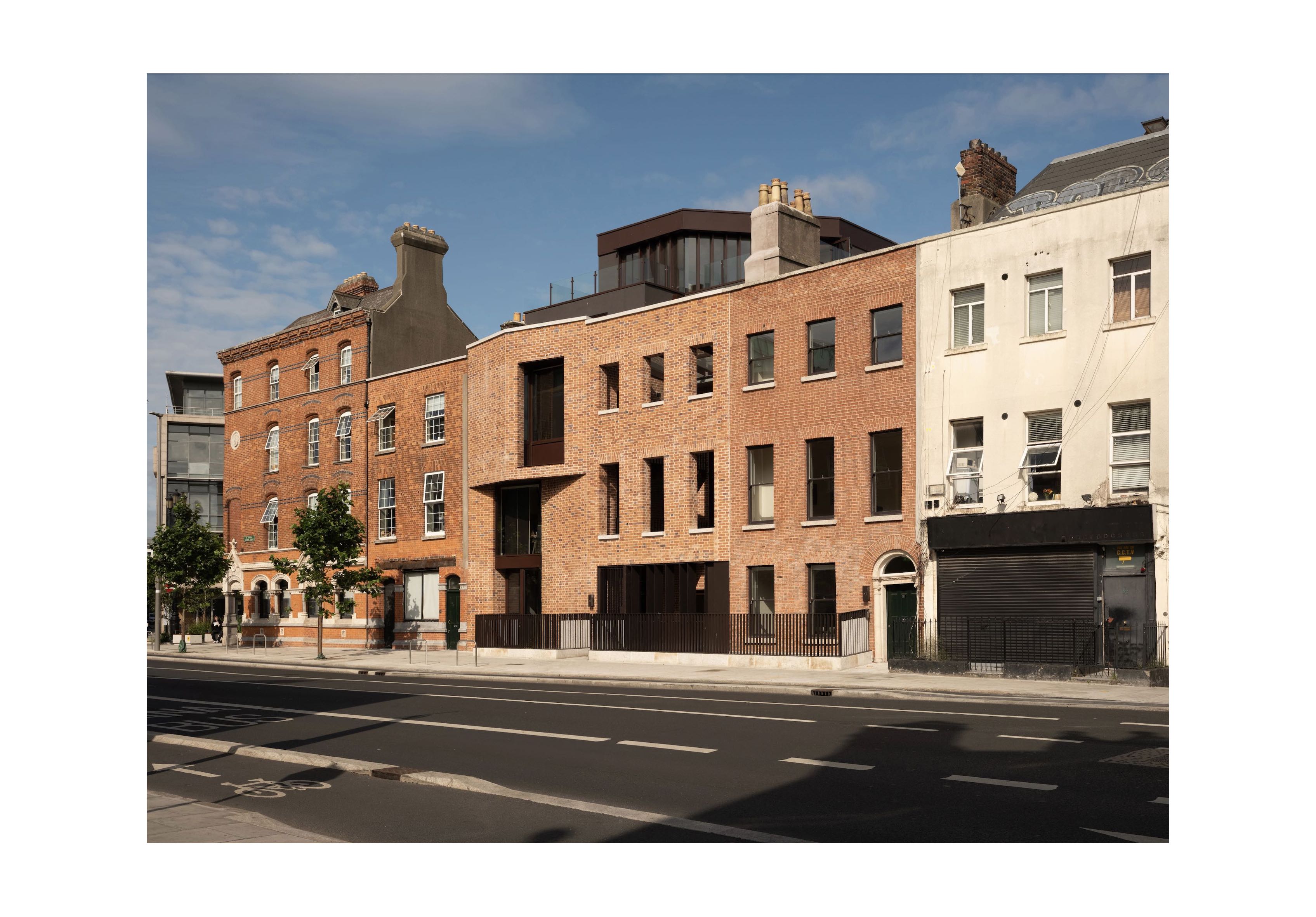


The project revitalises derelict 19th C. Georgian plots in Dublin, Ireland; by the careful integration of historic fabric and contemporary interventions new urban apartments are created. An atrium unifies and organises the site while preserving the site’s historic identity and connection to the streetscape.
Collaborators
Structure: CORA Structural and Civil Engineering; Consulting: Skelly and Associates Quantity Surveyors; Environmental: Richard Dixon and Associates; Fire Safety and Accessibility: ORS Building Consultants; Consulting: Hughes Planning and Development Consultants; Construction management: JV Ledwith Construction; Construction management: McDuff Construction; Collaborator (office): Shane Reid - Lawrence and Long Architects; Collaborator (office): Paul Weedle - Lawrence and Long Architects
Program
Collective housing
-
Labels
Courtyard · Social
Site area
423 m²
Total gross floor
836 m²
The historic Georgian buildings of Dublin form an integral part of the city core, and are characterised by elegant brick façades and harmonious streetscapes. The scheme reinterprets 3 vacant and derelict Georgian plots as an infill development. Original façades are retained and restored, and 11 new apartments and 2 commercial units are accommodated. A 3-storey open air atrium with a glazed roof provides a dignified entrance to the apartments as well as daylight, privacy, and acoustic separation from the busy inner city street; the reinstated details reinforce the historic rhythm of the terrace.
The project tackles the challenge of reintegrating a derelict site into a sensitive Georgian streetscape. Hemmed in by adjacent buildings, the site is constrained demanding a carefully orchestrated approach to it's construction. With No. 49 erased, No. 50 partially intact, and No. 51 structurally unsound, the design seeks to preserve, reveal, and celebrate the fragments of history that remain while enabling sustainable redevelopment. By setting the new structure behind the retained Georgian façade, an atrium is created to mediate between past and present, public and private realms—bringing light, ventilation, and acoustic separation. The site strategy reinstates original plot lines, balances density with liveability, and introduces a civic-scaled entrance that echoes the spatial generosity of Georgian architecture. The result is a contextually sensitive renewal that reactivates the historic fabric through 11no. apartments and ground-floor commercial units, revitalising the city’s core.
The overall method of construction, particularly the use of a steel frame and pre-fabricated elements including prestressed concrete floor slabs, were chosen due to restricted access to the site. This approach allowed the superstructure to be erected efficiently with minimal on-site fabrication. Historic façades were stabilised, repaired, and repointed following removal of cement render, with new façades and structure executed in reinforced concrete and steel. Lightweight assemblies reduce load on retained walls, and the glazed atrium roof introduces natural light deep into the plan. Apartments achieve BER A-ratings, and integrate energy efficiency & renewable systems, and airtight construction to ensure sustainability and long-term performance. Rainwater is managed through planters and permeable paving in landscaped courtyards. Durable materials - brick, metal, and glass - minimise maintenance, ensuring longevity and environmental responsibility within a sensitive heritage setting.