-

Streetview of annex and house with extention
-
The extention
-
The annex
-
Kitchen in the extention
-
Dance studio in the annex
-
Writer`s study in the extention
-
Site plane
-
Ground floor
-
First floor
-
Section annex. Elevation house, facade south-west.
-
Section annex. Elevation house, facade north-west
-
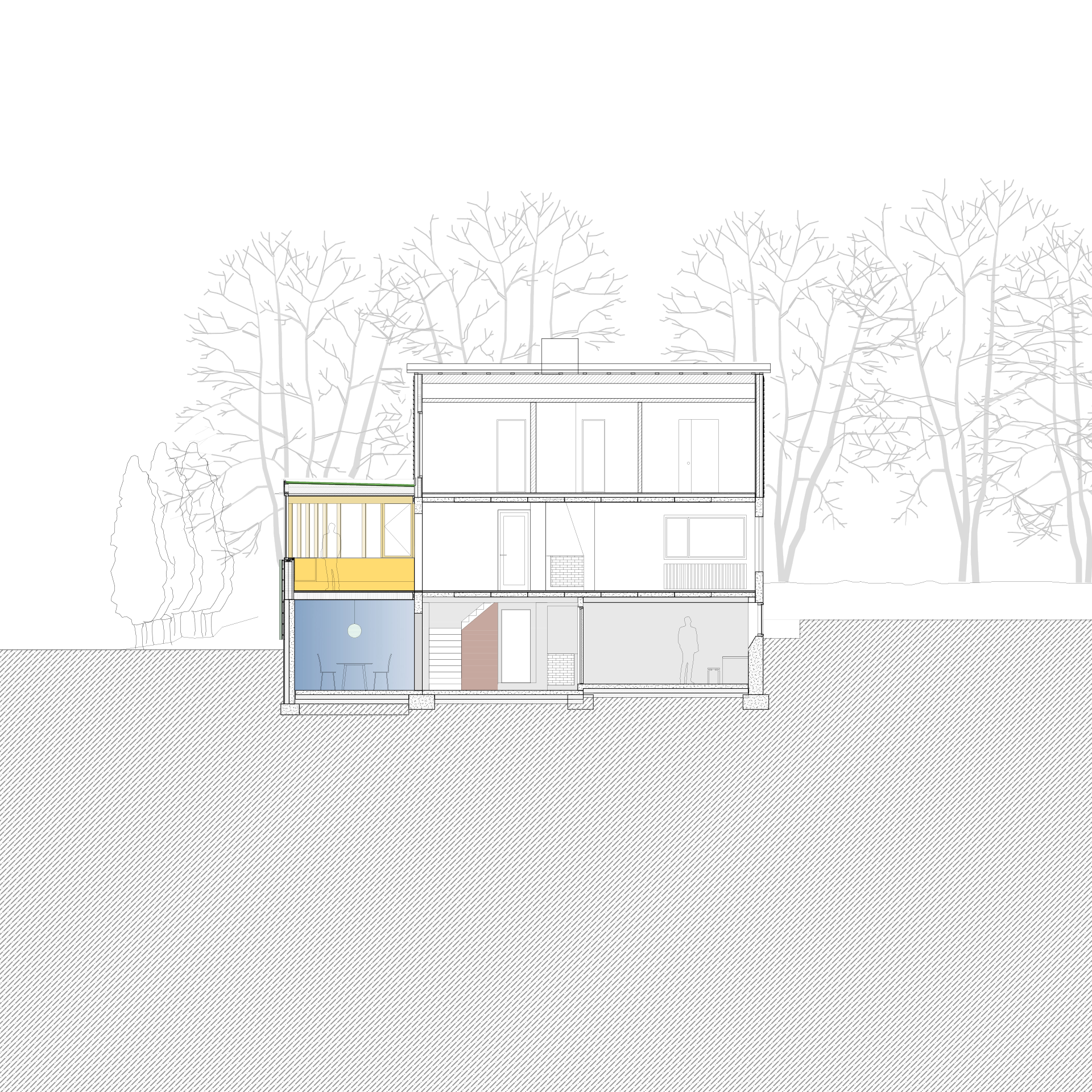
Section house and extention
1938 + 2023
mopo. Oslo, Norway
-
Name of work in English
1938 + 2023
-
Name of work in original language
1938+2023
Prize year
EUmies Awards 2026
-
Work Location
Oslo, Norway
-
Studio
mopo
EUmies Awards 2026 Nominees


Renovation and expansion of a 1938 house in central Oslo. The owners, a choreographer and a writer working from home, lacked suitable rooms and sufficient space to meet their needs. With a new extension and annex, the house now accommodates both family life and work.
Collaborators
Structure: Bollinger + Grohmann AS
Program
Single house
-
Labels
Isolated · Family
Site area
886 m²
-
Client
Ane Smoraas & Hugo Lauritz Jenssen
Total gross floor
265 m²
Cost
3840 €/m²
The original house has remained unchanged and is a beautiful example of functionalist architecture from the interwar period. Its volume, entrance, and finely shaped façade are distinctive features that lend this side of the house an almost formal character. By adding an extension and an annex placed on the least attractive parts of the site, new spaces were created for both family and work life. The detached annex contains a dance studio, a small living unit, and a garage, while the extension offers a spacious kitchen on the main floor and a writer`s study on the ground floor by the entrance.
An important architectural intention was for the existing house to retain its original distinctiveness, and for its history to remain legible even after the new interventions. The location of the extension and the annex was therefore designed so that they remain subordinate to the existing house and not block the visual connection between the old house and the street. Both the extension and the annex have been given a volume and detailing that do not attempt to copy the characteristics of the existing house, but instead assert their own architectural identity, clearly signalling what is original and what is new. The geometry combines curves and straight lines, forming volumes that echo the functionalist era’s characteristic features. The intention is that the interventions evoke such associations and function as a tribute to the property's period character. At the same time, kinship between the old house and the new elements has been pursued through materiality, scale, and colour.
The old house is a so-called “skirt-and-blouse” house, with a cast concrete base and a lighter timber structure above. The extension and annex continue this principle while also drawing on a Nordic tradition in which exposed timber structures play an important role in the interior. In both the extension and the annex, the upper floor is therefore constructed with pine columns and beams in a regular rhythm. The light construction allows for window bands that bring in daylight from multiple directions throughout the day. The facade cladding is vertical so that the curved volumes appear seamless. During the renovation, traces of the house’s original green colour were found. That same colour was reinstated on the old house as well as the extension and the annex. The neighbourhood was originally known for its colourful facades but has in recent decades become homogeneously white and grey. It was important for both the architect and owners to highlight the bolder use of colour from the past.