-

01 - CHENAL - NORTH EAST FACADES - Main facades from the bypass road (hidden facades until end of 2017)
-
02 - CHENAL - THE "SRTEET" PEDESTRIAN AREA - West facade on the left side and building B on the right side. Revegetalised strip make the seasons visible and solution for the level difference between building and site
-
03 - CHENAL - FACADE SOUTH - The new staircase and integration of the graphic design
-
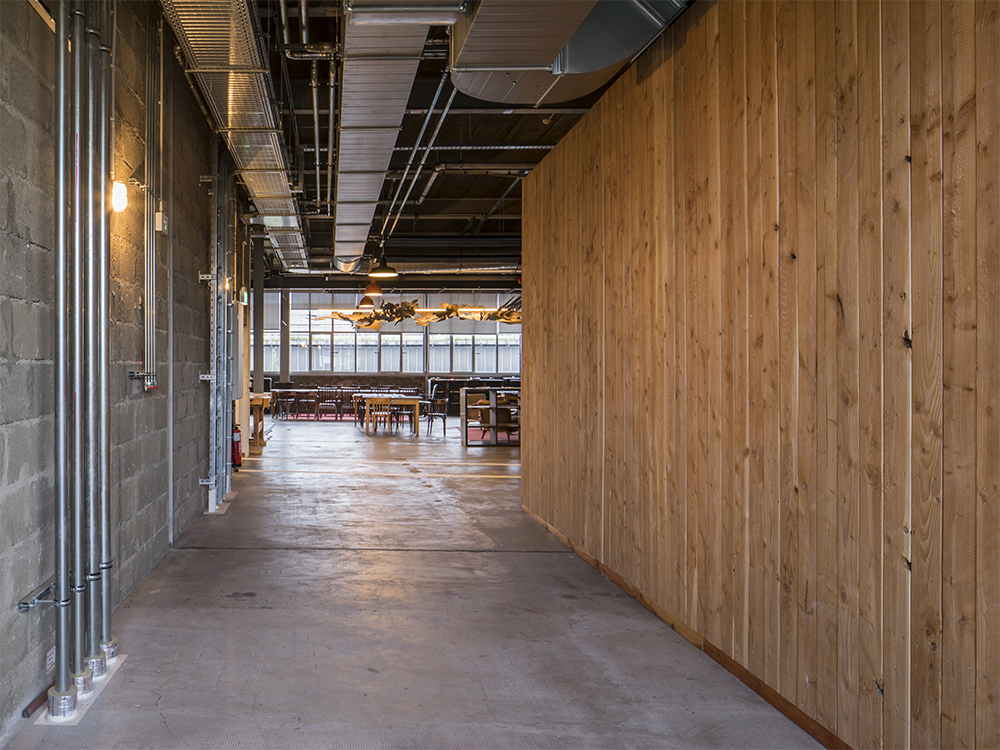
05 - DONEUX - FIRST FLOOR: NEW CREATIVE SPACES - Contrast between new Douglas fir boxes and steel/concrete existing structure
-
06 - CHENAL - FIRST FLOOR: NEW CREATIVE SPACES - Contrast between new Douglas fir boxes and visible technical installations, common multifunctionnal space with art installation from Misch Feinen
-
SITE PLAN – Situation of the site between urban space and large scale. Steel industry. Masterplan organizing the links between the 3 buildings of the site (1,6 hectare), the new by-pass road and the existing urban area. In red: the regulatory circulation
-
GROUND FLOOR PLAN – At the center: restaurant, professionnal kitchen and small event hall. On the left: the incubator’s 2 places (lounge entrance with kitchen + workspace), the meeting space, the creative spaces organized around this place and the fablab.
-
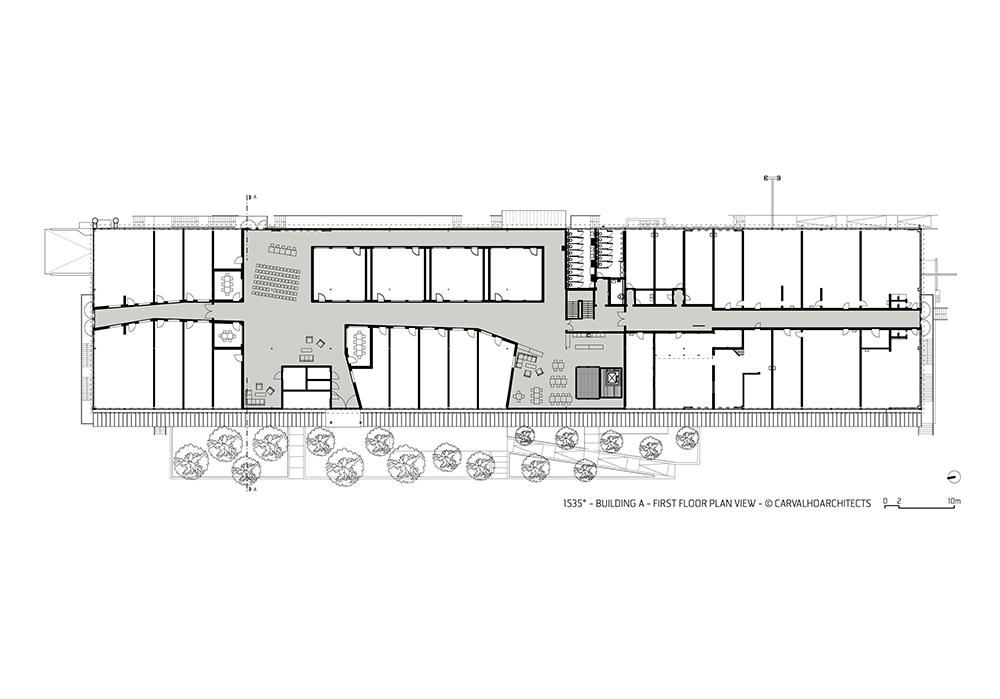
FIRST FLOOR PLAN – At the center: flexible common spaces, wooden boxes. On the left side: new creative spaces. On the right side: creation spaces in former sanitary spaces.
-
SECTION A – Ground floor: creative space and incubateur. The old maintenance pit is depolluted and kept in the space. The level difference between outside and inside is resolved by the «green strip» First floor: view from the flexible common space on the
-
SOUTH FACADE – First view: entrance from de old district. «Urban Street», renovated steel frames and structures, uncleaned bricks and multiple traces of previous uses (the facade seems to remains untouched). The wooden used for the staircases and «balcony
-
WEST FACADE – «Urban Street», renovated steel frames and structures, uncleaned bricks and multiple trace of previous uses (the facade seems to remains untouched). The wooden used for the staircases and «balcony», green strip.
-
10 - AMADO - FIRST FLOOR : FORMER PAINTING BOOTH - Appropriation of the space by an office.
-
12 - DI MAGGIO - DETAIL WINDOW HANDLE - Adaptation of a «sauterelle de menuisier» on the window.
-
1535° Creative Hub - A Building
carvalhoarchitects Sàrl. Differdange, Luxembourg
-
Name of work in English
1535° Creative Hub - A Building
-
Name of work in original language
1535° Creative Hub - bâtiment A
Prize year
EUmies Awards 2017
-
Work Location
Differdange, Luxembourg
-
Studio
carvalhoarchitects Sàrl
EUmies Awards 2017 Nominees






Collaborators
Program
Mixed use - Commercial & Offices
-
Labels
Aggregation · Media · Food · Store · Office
Site area
16.56 m²
-
Client
Ville de Differdange
Total gross floor
6.257 m²
Completion
2015
The 1535° project develops a 1.6-hectare plot of land in the city centre, separated from a steel production site through the construction of a bypass road. It is part of a socio-economic redevelopment program elaborated by the industrial city of Differdange. The site, currently hidden between worker housing and an industrial area, will soon be located at the entrance of the city. It is intended to act as temporal, spatial, functional and symbolic interface between old and new, residents and users, local and global actors. The overall project involves the rehabilitation of three industrial buildings (A, B, C) and foresees landscaping work. Building A hosts 42 artists, small and medium-sized businesses in the creative economy sector, municipal services, a restaurant, an event hall, a fablab and an incubator for the social and solidarity economy.
With the purpose of diversifying its socioeconomic fabric, the city would like to provide creative entrepreneurs with connected lowcost, and flexible work spaces. It aims to promote its industrial heritage through a sensitive renovation project, updating a workshop built in 1962 to current standards. The intervention must create a strong identity, one that radiates beyond the borders of Luxembourg to attract players in this sector. The project is inspired by the ideals of architectural structuralism. It is designed as a village, housed in a structure made of steel, concrete and glass. This symbolises the recolonisation in a "plan libre" of oversized industrial spaces by new players on both local and global levels. The distribution areas have been rethought to promote facetoface relations and increase opportunities for exchange: for example, the lift is integrated in the space of the common kitchen. This space is equipped for conferences, concerts, casual meetings and exhibitions. The 1535° is a social project whose nontechnical work has been carried out by backtowork associations for the unemployed. The design has been studied to meet this constraint.
The raw aspect of the industrial context serves as an anchor for a new identity, making it possible to highlight the different layers of the passage of time: uncleaned bricks, existing steel frames and steel structures, partial use of transparent paint, multiple traces of previous uses. New interventions are integrated in continuity with this raw aspect or as a contrast. In the first instance, the technical networks are visible. In the second, the use of Douglas fir or spruce is preferred. The basic human action of repetition of a board or a post is elaborated in different variations. The design has been intentionally conceived as just another step in the story of the building. Tenants appropriate the space and help build the identity of 1535° by adding their own identity. Focus has not been placed on insulating but on extensive decontamination and on minimizing the production of C02 in a post peak oil strategy: urban pellet heating, solar panels, double-glazing in existing steel frames, revegetation in partnership with Transition Town, urban bicycle station, electrical terminals. In the logic of a circular economy, the furnishings have been mostly recovered and loaned.